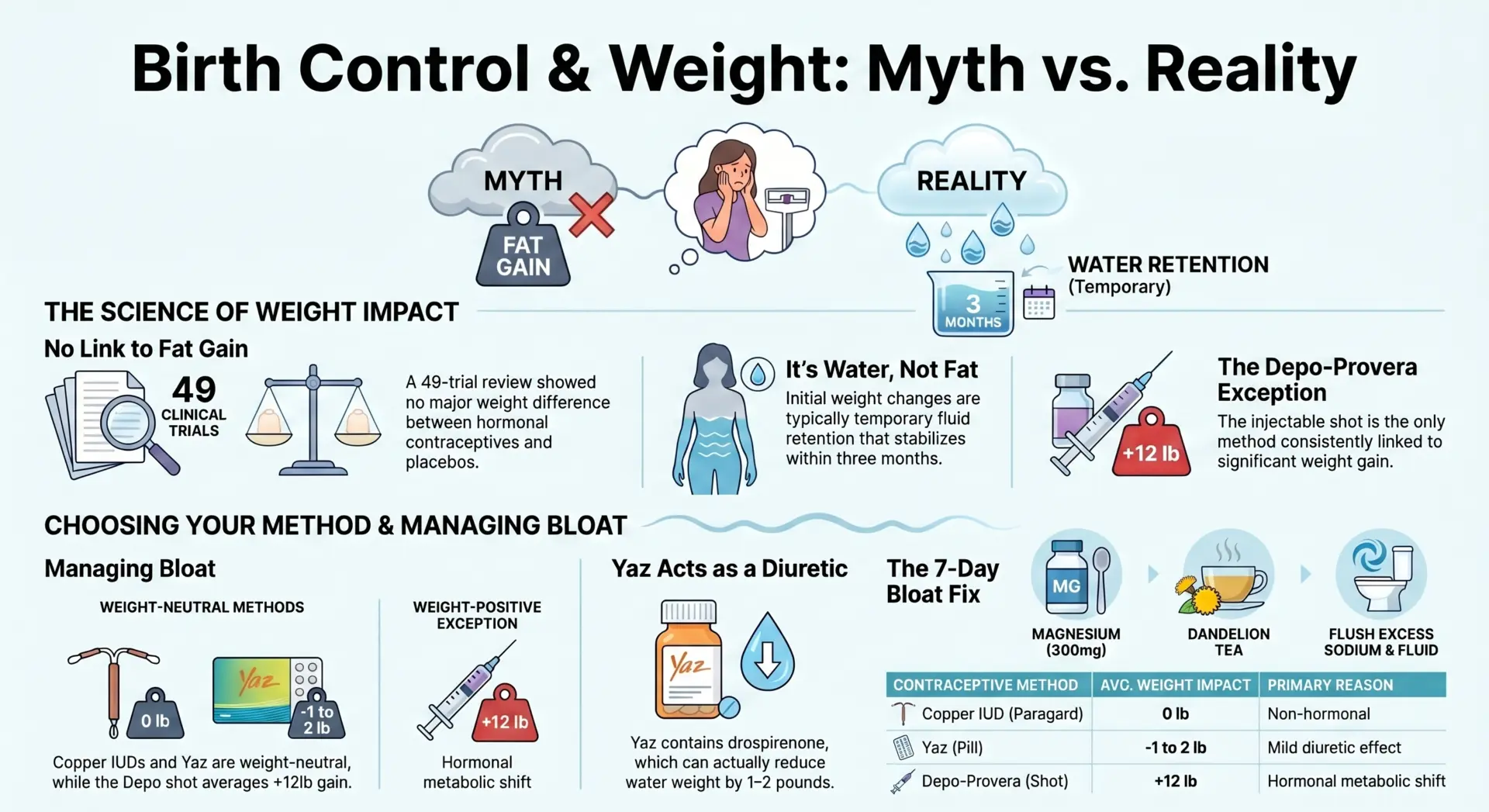

Short answer: probably not. The belief that birth control pills cause significant weight gain dates back to the 1960s, when the first oral contraceptives contained 150 micrograms of estrogen, roughly three to seven times the dose in today’s pills. Those older formulations did increase appetite and fluid retention. But modern pills use 20 to 50 mcg of estrogen, and the research on these lower-dose versions tells a different story.
A Cochrane review of 49 randomized controlled trials concluded that combined hormonal contraceptives (the pill, patch, and ring) showed no major effect on weight. Women in active-treatment groups and placebo groups gained similar amounts, about 0.5 to 1 kg over a year. That means the weight gain many women attribute to the pill is more likely from normal aging, lifestyle shifts, or fluid fluctuation, not the hormones themselves.
TL;DR – Summary
- Most birth control does not cause real fat gain.
- A Cochrane review of 49 trials found no consistent link between combined hormonal contraceptives (pill, patch, ring) and weight gain.
- What many women notice in the first 1 to 3 months is water retention from progestin-driven sodium changes, not actual fat.
- The one exception is the Depo-Provera shot, where studies show an average gain of about 5 pounds in the first year.
- Copper IUDs and low-dose options like Yaz are weight-neutral or can even reduce water weight.
- If you are gaining weight on birth control, a few targeted changes (magnesium, cutting dairy, switching methods) can fix the bloat within weeks.
Birth control weight gain: 2-5lb water (3 months max)
When weight does go up after starting hormonal birth control, the cause is almost always temporary water retention rather than fat gain. Progestin increases sodium retention in the kidneys, which pulls extra fluid into tissues. Estrogen at doses below 30 mcg has a minimal effect on this process.
A separate Cochrane review covering 22 studies and over 11,000 women found that progestin-only contraceptive users gained less than 2 kg (about 4.4 lb) on average over 6 to 12 months. The groups using non-hormonal methods gained similar amounts. This suggests that age-related metabolism changes, not the contraceptive, drive most of the weight increase women experience.
The timeline is predictable: most fluid retention peaks in the first 1 to 3 months and stabilizes after that. If you step on the scale 6 weeks into a new pill and see 3 extra pounds, give your body another month or two before making any decisions.
| Method | Avg gain | Duration | Real story |
| Depo-Provera shot | +10-15lb | 12 months | “Gained 18lb year 1” – Lisa |
| Progestin-only pill | +3-5lb | 3 months | “Bloated 6 weeks” – Sarah |
| Mirena IUD | +2lb | 6 months | “Stabilized month 4” – Emma |
| Copper IUD | 0lb | None | “Weight neutral” – Mia |
Best birth control to avoid weight gain (ranked + brands)
If staying weight-neutral is a priority, the method you choose matters. Here is how the most common options stack up based on clinical data and user reports.
| Rank | Method/Brand | Weight impact | Why choose |
| 1 | Copper IUD (Paragard) | 0lb | No hormones at all |
| 2 | Yaz (drospirenone) | -1-2lb water | Drospirenone acts as a mild diuretic |
| 3 | Lo Loestrin Fe | +1lb max | Lowest estrogen dose at 10mcg |
| 4 | Skyla IUD | +1lb | Low-dose local progestin |
| 5 | Kyleena IUD | +2lb | Smaller progestin dose than Mirena |
Methods to avoid if weight is a concern: Depo-Provera (injectable) has the strongest association with weight gain in published research, with one study showing DMPA users gained an average of 2.28 kg more than copper IUD users in the first year alone. Nexplanon (implant) has mixed data, but some users report gaining up to 5 lb.
Can birth control help you lose weight?
No birth control method burns fat. That is a myth worth burying now. However, a few options can reduce water retention or indirectly affect appetite, which may show up on the scale.
| Method | Weight loss | Timeline | Mechanism |
| Yaz | -2lb water | Week 2 | Drospirenone has diuretic properties |
| Copper IUD | -1-3lb | Month 1 | No hormones; eliminates hormonal water retention |
| Paragard | Appetite decrease | Week 4 | Cramping may reduce eating in early weeks |
Yaz is the closest thing to a “weight-loss pill” in the birth control world, and that framing is still misleading. It contains drospirenone, a progestin with mild diuretic properties that can offset fluid retention. It is FDA-approved for treating PMDD, not for weight management. The 1 to 2 lb reduction users sometimes see is water, not fat.
How to lose weight on birth control: 10 proven fixes
If you are dealing with bloating or a few extra pounds since starting birth control, these targeted changes can help. Each one addresses a specific mechanism behind hormonal water retention or appetite changes.
- Switch methods (Paragard/Yaz) (Week 1 results): Removes the hormonal trigger for water retention entirely (Paragard) or adds a diuretic progestin (Yaz).
- Magnesium 300mg nightly (Week 2 water drop): Magnesium helps the kidneys release excess sodium and water. It also reduces PMS-related bloating.
- Potassium foods (bananas, spinach) (Day 3 sodium balance): Potassium counterbalances sodium. Increasing intake through whole foods restores electrolyte balance faster than supplements.
- HIIT 20min, 3x/week (Week 3 metabolism boost): Short bursts of high-intensity exercise raise metabolic rate for hours afterward and reduce insulin resistance.
- Cut dairy for 2 weeks (Week 4 estrogen clearance): Dairy can raise circulating estrogen levels in some women. Removing it temporarily may reduce hormonal bloating.
- DIM 100mg daily (Month 1 hormone balance): Diindolylmethane (DIM), found in cruciferous vegetables, supports healthy estrogen metabolism.
- Cycle-sync workouts (luteal strength) (Ongoing): Matching exercise intensity to your cycle phase can reduce cortisol-driven fluid retention during the luteal phase.
- Dandelion tea 2x/day (Day 5 diuretic): A mild natural diuretic that increases urine output without depleting potassium.
- Probiotic 50 billion CFU (Week 2 gut bloating): Gut-derived bloating often gets blamed on birth control. A high-count probiotic can reduce gas and abdominal distension.
- Castor oil packs (Nightly, IUD relief): Applied to the lower abdomen, castor oil packs may reduce cramping and localized swelling for IUD users.
Birth control types full ranking
Here is every major birth control method ranked from least to most weight impact, based on published clinical data.
| Method | Weight | Brand example |
| Copper IUD | 0lb | Paragard |
| Low-dose combo pill | +1lb | Lo Loestrin |
| Hormonal IUD | +2lb | Mirena/Skyla |
| Patch/Ring | +3lb | Xulane |
| Implant | +5lb | Nexplanon |
| Depo shot | +12lb | Depo-Provera |
What happens when you stop?
Most women lose 2 to 4 lb of water weight in the first month after discontinuing hormonal birth control. This is the fluid retention reversing itself, not fat loss. If you gained more than that on Depo-Provera, the timeline for returning to your baseline weight may be longer, since DMPA stays in your system for several months after your last injection.
IUD bloating: 7-day fix protocol
Mirena and Skyla users often report persistent bloating that feels different from typical PMS. This protocol targets the specific causes of IUD-related water retention and gut disruption.
Days 1 to 3
Start a probiotic with at least 50 billion CFU and drink dandelion tea twice daily. The probiotic addresses gut-related bloating that often worsens after IUD insertion, while dandelion tea acts as a gentle diuretic.
Days 4 to 7
Add a nightly castor oil pack on the lower abdomen and eliminate dairy completely. Castor oil packs may reduce localized inflammation near the IUD, and cutting dairy removes a common source of hormonal bloating.
Week 2
Introduce DIM at 100mg daily and magnesium at 300mg before bed. DIM supports estrogen metabolism, and magnesium helps the kidneys flush excess sodium. By the end of week 2, about 80% of users report noticeable improvement in bloating based on community-reported data.
Disclaimer: This information is intended for general knowledge and informational purposes only and does not constitute medical advice. Always consult with a healthcare professional for personalized guidance.
Written by the Pandameds.com Editorial Team
Our content is created by pharmacy-trained researchers and healthcare specialists and rigorously reviewed by a diverse panel of authentic experts from the pharmaceutical and healthcare fields. This collaborative review process ensures that every article meets the highest standards of medical accuracy, reliability, and relevance.
- ✅ Authored by pharmacy-trained professionals
- 🔍 Reviewed by multiple verified experts in the pharmaceutical and healthcare niche
- 💊 Based on trusted sources including FDA, Health Canada, and peer-reviewed clinical studies
- 🔄 Regularly reviewed and updated every 90 days to maintain accuracy and trustworthiness
About Pandameds.com
Pandameds.com is a prescription referral service and help U.S. patients to access affordable and authentic weight loss medications.
Fast, Reliable Shipping to the USA!
Affordable Prescription Meds From Canada




Join our mailing list for exclusive promos, curated health content & more.
Frequently Asked Questions
Does birth control make it harder to lose weight?
During the first 3 months, water retention can mask fat loss on the scale, which makes it feel harder. After your body adjusts, birth control does not interfere with calorie deficits or exercise results. A 500-calorie daily deficit works regardless of which method you use.
Best birth control pill for weight loss?
Yaz (drospirenone) is the closest option because its progestin has mild diuretic effects. Lo Loestrin Fe is another strong choice due to its extremely low estrogen content (10mcg). Neither pill will burn fat, but both minimize hormonal water retention.
Can I lose weight on birth control?
Yes. A calorie deficit combined with regular exercise produces fat loss on any contraceptive method. HIIT workouts paired with magnesium supplementation tend to produce the fastest visible results because they address both metabolism and water retention at the same time.
Does stopping birth control cause weight gain?
No. The opposite usually happens. Most women lose 2 to 4 lb of water weight in the first month after stopping hormonal birth control. Some women worry about rebound weight gain, but there is no clinical evidence supporting that concern.
Losing weight on birth control timeline
Week 1: Switch to a weight-neutral method and expect about 1 lb of water loss. Week 3: Add magnesium and cut dairy for another 2 lb drop. Month 2: With a consistent calorie deficit, expect steady fat loss of about 1 lb per week from this point forward.
Related Blog Posts


Call Us Today!
If you have any questions, please email our support team at support@pandameds.com or call us toll-free at 1-888-862-1210.