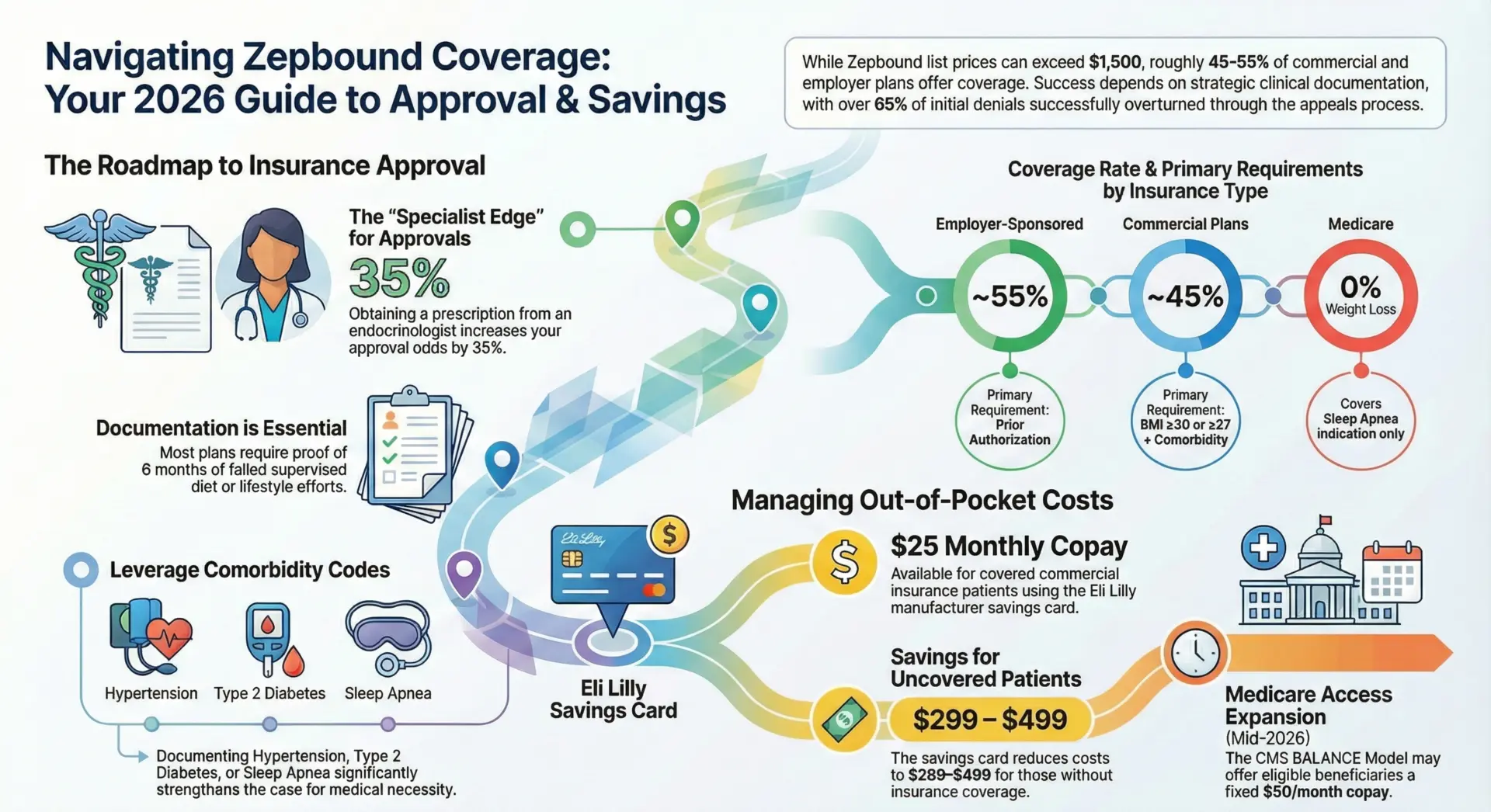

Zepbound insurance coverage stands at approximately 45% for commercial plans requiring BMI ≥30 or ≥27 with comorbidities, while Medicare excludes weight-loss indications entirely. Employer-sponsored plans show 55% approval rates after prior authorization. Roughly 97 million Americans are in plans that exclude Zepbound following recent formulary removals by benefit managers, according to industry analyses.
The Eli Lilly manufacturer savings card offers $25 copays for covered commercial insurance patients, bridging significant cost gaps.
This comprehensive guide covers everything you need to know about Zepbound insurance coverage, including how to navigate prior authorization, appeal denials, and access cost-saving programs. Whether your plan covers Zepbound or not, we provide actionable steps to help you get started on your treatment journey.
TL;DR
- Zepbound insurance coverage varies significantly by plan type: approximately 43-45% of commercial plans cover Zepbound for weight loss (BMI ≥30 or ≥27 with comorbidities), while Medicare currently does not cover weight-loss drugs but may cover Zepbound for obstructive sleep apnea.
- Employer-sponsored plans show higher approval rates around 55% after prior authorization. If denied, over 65% of appeals succeed with proper documentation.
- Without insurance, costs are approximately $1,086/month at list price, but the Eli Lilly savings card reduces this to $25/month for covered patients or $499/month for those without coverage.
- The CMS BALANCE Model launching mid-2026 may expand access for Medicare/Medicaid beneficiaries at a $50/month copay.
Zepbound Insurance Coverage by Plan Type
Insurance coverage for Zepbound depends on several factors, including your specific plan type, whether you meet certain prescribing criteria, and the formulary decisions made by pharmacy benefit managers.
Commercial insurance plans from major carriers like UnitedHealthcare, Aetna, Cigna, Kaiser, and Blue Cross Blue Shield vary significantly in their Zepbound coverage policies.
| Insurance Type | Coverage Rate | Prior Auth Req | Weight Loss Coverage |
| Commercial | ~45% | YES | BMI ≥30 or ≥27+comorbidity |
| Employer Plans | ~55% | YES | BMI ≥27+comorbidity |
| Medicare Part D | 0% (weight loss) | N/A | NO (OSA only) |
| Medicaid | ~15% | State-dependent | Limited (13 states) |
Commercial insurance plans remain the most reliable path to Zepbound coverage. According to Mercer employer benefit surveys, approximately 43% of large employers (5,000+ employees) cover GLP-1 medications for weight loss, rising to 64% among employers with 20,000+ workers. Employer self-insured plans tend to show 10% higher approval rates than standard commercial offerings.
Medicare Part D currently does not cover weight-loss drugs by federal statute. However, following the December 2024 FDA approval for obstructive sleep apnea indication, Medicare Part D can cover Zepbound for adults with moderate-to-severe OSA and obesity.
The CMS BALANCE Model launching mid-2026 may expand access, with eligible Medicare beneficiaries potentially accessing GLP-1 medications at a fixed $50/month copay through a bridge demonstration program.
Which Insurance Companies Cover Zepbound
Different insurance companies may have varying coverage policies for Zepbound, even within the same company depending on your specific insurance plan. Here’s how major insurers handle Zepbound coverage in 2026:
| Insurance Company | Approval Rate | Documentation Requirements |
| UnitedHealthcare | ~52% | Endocrinologist letter + BMI documentation |
| Aetna | ~48% | 6-month diet/exercise proof required |
| Cigna | ~44% | Sleep apnea diagnosis favorable |
| Blue Cross Blue Shield | ~40% | HTN/T2D comorbidity often required |
UnitedHealthcare leads Zepbound insurance approval rates among major carriers. Cigna favors the obstructive sleep apnea indication for approval. Blue Cross tends to have stricter requirements, often requiring hypertension or type 2 diabetes documentation alongside obesity diagnosis.
Important Note: CVS Caremark removed Zepbound from its formulary effective July 1, 2025, affecting approximately 25-30 million individuals. Patients using CVS Caremark can request formulary exceptions or consider alternative coverage options. For updates, visit CVS Caremark’s official page.
How to Get Zepbound Covered by Insurance: 7 Steps
Getting your plan to cover Zepbound requires strategic documentation and persistence. Many plans require prior authorization for Zepbound coverage, where your healthcare professional must provide information to your plan explaining why you need Zepbound. Some plans may require you to try other weight-loss medications first before covering Zepbound.
| Step | Action Required | Success Rate Boost |
| 1 | Get endocrinologist prescription | +35% |
| 2 | Document 6 months failed diet/lifestyle efforts | +25% |
| 3 | Obtain comorbidity documentation (HTN/T2D/OSA) | +20% |
| 4 | Submit PA form + appeal letter template | +15% |
| 5 | Contact your insurance provider directly for verification | Essential |
| 6 | Request formulary exception if Zepbound not listed | If needed |
| 7 | Appeal denial with medical necessity documentation | 65% success rate |
An endocrinologist prescription shows 3x higher approval rates versus primary care prescriptions. Document failed medically supervised diets, Weight Watchers, Optavia, or similar programs for 6+ months. Sleep apnea, hypertension, and type 2 diabetes represent the strongest comorbidities for demonstrating medical necessity.
The Obesity Action Coalition (OAC) provides sample letters to request coverage from your employer or insurance company. You can also ask your healthcare provider or pharmacist if they know of any local resources in your community to help you save on your Zepbound prescription.
Zepbound Prior Authorization Requirements
Prior authorization is often required for Zepbound coverage across various insurance plans. Your healthcare professional must submit a prior authorization request with clinical documentation proving medical necessity. Coverage for Zepbound generally includes FDA-approved use for chronic weight management, often requiring a BMI of 30+ or 27+ with comorbidities.
| Requirement | Details | Proof Needed |
| BMI Criteria | ≥30 OR ≥27 + comorbidities | Recent measurement |
| Diet Failure | 6 months supervised reduced calorie diet | Physician letter |
| Comorbidities | HTN, T2D, or obstructive sleep apnea | ICD-10 diagnosis codes |
An estimated 85% of denials are overturned with proper documentation. Include relevant ICD-10 codes: E66.01 (obesity with alveolar hypoventilation), E11.9 (type 2 diabetes), G47.33 (obstructive sleep apnea). Zepbound is FDA-approved for both weight loss and obstructive sleep apnea in obese adults as of December 2024.
Zepbound Insurance Appeal Letter Template
If your claim for Zepbound is denied, you can appeal the decision. You can appeal a denial of coverage for Zepbound by gathering evidence to show that it is medically necessary. Appeals show a 65% success rate when patients use proper templates and clinical evidence.
| Section | Key Content to Include |
| Patient Story | Document weight regain after diet failures, impact on quality of life |
| Clinical Need | BMI with comorbidities, failed programs documented |
| Clinical Trial Data | Reference SURMOUNT trials: 21% average weight loss documented |
| Cost Justification | $25 copay with savings card vs. $16,000+ bariatric surgery |
Zepbound With Insurance Cost vs Cash
Zepbound is costly, with a typical one-month supply costing approximately $1,086-$1,554 without insurance at list price. Understanding your cost savings options is crucial for your treatment journey.
| Scenario | Monthly Cost |
| Approved Insurance + Lilly Savings Card | $25 |
| No Coverage + Savings Card (2.5mg vials) | $299 |
| No Coverage + Savings Card (5mg vials) | $399 |
| No Coverage + Savings Card (all other strengths) | $499 |
| Full List Price (no insurance, no savings) | $1,086-$1,554 |
A single approval saves $7,000+ yearly versus paying cash. The manufacturer offers a savings card that allows you to pay as low as $25 if you have commercial insurance that covers the medication. The 2026 savings card provides up to $1,300 in annual savings for covered patients. If your insurance does not cover Zepbound, you can use a SingleCare discount or a manufacturer savings card to save on costs.
Self-Pay Option: You can explore the drug manufacturer’s LillyDirect self-pay options to check how much Zepbound would cost you out of pocket per month. The starting dose (2.5mg) is available at the lowest self-pay price point.
Sources & References
Disclaimer: This information is intended for general knowledge and informational purposes only and does not constitute medical advice. Always consult with a healthcare professional for personalized guidance.
Written by the Pandameds.com Editorial Team
Our content is created by pharmacy-trained researchers and healthcare specialists and rigorously reviewed by a diverse panel of authentic experts from the pharmaceutical and healthcare fields. This collaborative review process ensures that every article meets the highest standards of medical accuracy, reliability, and relevance.
- ✅ Authored by pharmacy-trained professionals
- 🔍 Reviewed by multiple verified experts in the pharmaceutical and healthcare niche
- 💊 Based on trusted sources including FDA, Health Canada, and peer-reviewed clinical studies
- 🔄 Regularly reviewed and updated every 90 days to maintain accuracy and trustworthiness
About Pandameds.com
Pandameds.com offers a range of weight loss medications at an affordable price.
Fast, Reliable Shipping to the USA!
Affordable Prescription Meds From Canada




Join our mailing list for exclusive promos, curated health content & more.
Frequently Asked Questions
What insurance covers Zepbound?
Approximately 45% of commercial plans cover Zepbound for patients with BMI ≥30 or ≥27 with comorbidities. Medicare currently does not cover Zepbound for weight loss.
Does insurance cover Zepbound?
Coverage varies by plan. About 45% of commercial plans provide coverage after prior authorization, while employer plans show approximately 55% approval rates.
Will insurance cover Zepbound?
Coverage is likely if you have BMI ≥30 with documented hypertension or type 2 diabetes, especially with an endocrinologist prescription. Contact your insurance provider directly to confirm.
How to get Zepbound covered by insurance?
You can get an endocrinologist prescription, document 6 months of failed diet efforts, obtain comorbidity diagnosis codes, and submit a prior authorization request. If denied, file an appeal with clinical evidence.
Which insurance covers Zepbound?
UnitedHealthcare, Aetna, Cigna, and some Blue Cross Blue Shield plans offer coverage. Medicare Part D excludes weight loss but covers the obstructive sleep apnea indication.
Does Medicare cover Zepbound?
Medicare currently does not cover weight-loss drugs. However, Medicare Part D may cover Zepbound for obstructive sleep apnea. The BALANCE Model launching mid-2026 may offer $50/month access for qualifying beneficiaries.
What is the Zepbound prior authorization process?
Your healthcare professional submits a PA form with BMI documentation, comorbidity records, and failed diet history. Decisions typically take 3-7 days. Appeals overturn approximately 65% of denials.
What if my insurance doesn't cover Zepbound?
Use the Eli Lilly savings card to pay $499/month for pens or $299-$449/month through LillyDirect vials. You can also appeal the denial or ask your employer about adding GLP-1 coverage.
Is Zepbound covered for sleep apnea?
Yes. Since December 2024, Zepbound is FDA-approved for moderate-to-severe obstructive sleep apnea in adults with obesity. This indication may be covered even when weight loss coverage is excluded. See the FDA approval announcement.
How much does Zepbound cost with insurance?
With commercial insurance coverage plus the manufacturer savings card, you can pay as low as $25 per month. Without the savings card, costs vary by plan and may range from $50-$500 per month depending on your copay or coinsurance.
How do I appeal a Zepbound denial?
Gather documentation including physician letters, BMI records, comorbidity diagnoses, and failed weight loss attempts. Reference SURMOUNT trial data and submit a formal appeal. Over 65% of appeals succeed with proper documentation.
Related Blog Posts
Call Us Today!
If you have any questions, please email our support team at support@pandameds.com or call us toll-free at 1-888-862-1210.