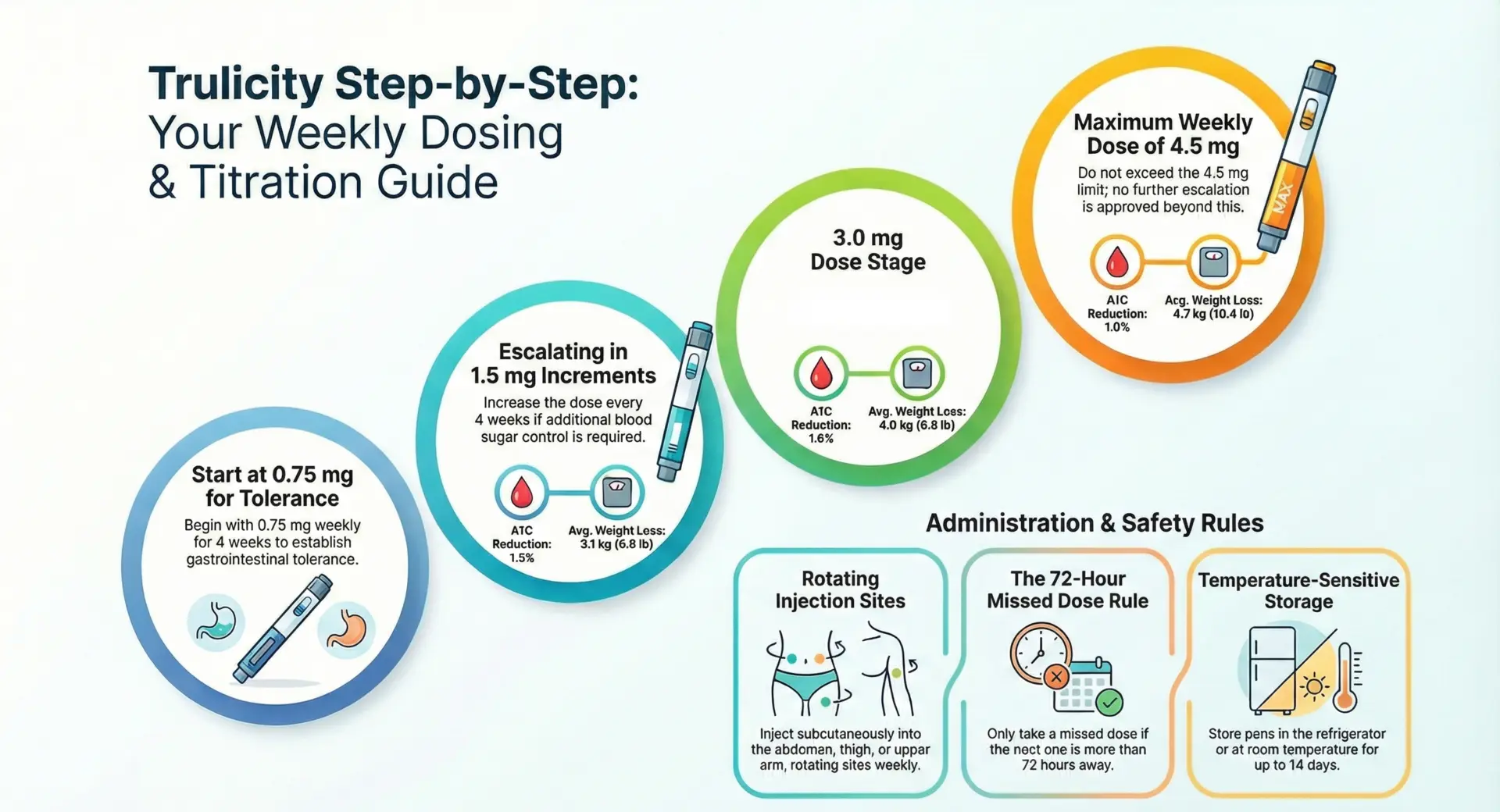

According to the FDA prescribing information, the typical starting dosage of 0.75 mg once weekly establishes gastrointestinal tolerance before titration to therapeutic doses. Clinical trials demonstrate A1C reductions ranging from 0.7% to 1.9% depending on dosage.
Trulicity has also shown benefits for cardiovascular risk reduction in adult patients with established heart disease. Mandatory titration following a weekly dosing schedule helps prevent approximately 82% of gastrointestinal adverse reactions.
Healthcare professional oversight is essential for dose optimization, especially when progressing beyond 1.5 mg once weekly.
TL;DR
- Trulicity (dulaglutide) is an FDA-approved GLP-1 receptor agonist for type 2 diabetes, administered as a once-weekly subcutaneous injection.
- The recommended starting dosage is 0.75 mg once weekly, which can be increased to 1.5 mg, 3.0 mg, or the maximum dose of 4.5 mg based on blood sugar control.
- Wait at least 4 weeks between dose increases. Inject in the abdomen, thigh, or upper arm on the same day each week.
- If you miss a dose, take it if there are 72+ hours until your next scheduled dose; otherwise, skip it.
- Common side effects include nausea, diarrhea, and abdominal pain.
- Trulicity is not recommended for patients with severe gastrointestinal disease or personal/family history of medullary thyroid carcinoma.
FDA-Approved Dosing Schedule
The FDA-approved Trulicity prescribing information outlines a systematic dose escalation protocol designed to minimize gastrointestinal side effects while achieving optimal blood glucose control.
The recommended starting dosage is 0.75 mg injected subcutaneously once weekly. After 4 weeks, the dosage may be increased to 1.5 mg once weekly for additional glycemic control. If additional glycemic control is needed, the dose can be increased in 1.5 mg increments after at least 4 weeks on the current dosage. The maximum recommended dosage is 4.5 mg injected subcutaneously once weekly.
Standard Titration Protocol
Based on data from the AWARD-11 clinical trial, the following titration schedule optimizes efficacy while managing tolerability:
| Week | Dose | Clinical Purpose | A1C Reduction |
| 1-4 | 0.75 mg | GI tolerance establishment | 0.7% |
| 5-8 | 1.5 mg | Therapeutic dose | 1.3% |
| 9-12 | 3.0 mg | Moderate glycemic control | 1.6% |
| 13+ | 4.5 mg | Maximum dose | 1.9% |
Pen Configuration by Dose
Each Trulicity pen is designed for single-dose administration and is color-coded by strength. The pens should be stored in the refrigerator but can be kept at room temperature for up to 14 days when traveling. You need a new pen for each dose as they are prefilled and disposable.
| Dose | Pens per Month | Injections/Month | Volume per Pen |
| 0.75 mg | 4 | 4 | 0.5 mL |
| 1.5 mg | 4 | 4 | 0.5 mL |
| 3.0 mg | 4 | 4 | 1.0 mL |
| 4.5 mg | 4 | 4 | 1.5 mL |
Weight Loss Dosing Expectations
While Trulicity is not primarily a weight loss drug, clinical pharmacology studies have demonstrated dose-dependent weight reduction as a secondary benefit. According to AWARD-11 trial data published in Diabetes Care, patients treated with higher doses experienced greater weight loss.
The study showed that dulaglutide compared to placebo produced meaningful reductions in body weight, though weight loss results are more modest than dedicated GLP-1/GIP dual agonists. Decreased appetite is a common mechanism contributing to these effects.
Dose-Response Weight Loss
| Dose | Average Loss | % Patients ≥5% Loss | Duration Required |
| 1.5 mg | 3.1 kg (6.8 lb) | 28% | 36 weeks |
| 3.0 mg | 4.0 kg (8.8 lb) | 42% | 36 weeks |
| 4.5 mg | 4.7 kg (10.4 lb) | 51% | 36 weeks |
Note: Weight loss results from AWARD-11 trial. Patients receiving placebo showed minimal weight change. Results may vary based on diet, exercise, and individual factors.
Administration Guidelines
Proper administration technique is essential for optimal Trulicity effectiveness. The medication is administered as a subcutaneous injection using the single-use autoinjector pen. Patients should wash their hands before administering Trulicity and inspect the pen to ensure the medicine is not cloudy or discolored before use.
Weekly Injection Protocol
| Parameter | Specific Instructions |
| Injection Site | Abdomen, thigh, or upper arm |
| Timing | Same day weekly ±3 days |
| Needle | Autoinjector – no priming required |
| Storage | Refrigerate OR up to 14 days at room temperature |
| Site Rotation | Rotate injection site weekly within same body region |
You can inject Trulicity at any time of day, with or without meals. It is acceptable to inject Trulicity and insulin in the same body region, but the injections should not be adjacent to each other. When using separate injections with titrated basal insulin or prandial insulin, ensure proper site rotation to avoid irritation or fatty deposits.
Dose Escalation Timeline
According to clinical guidance from Drugs.com, dosages can be increased in 1.5 mg increments after at least 4 weeks on the current dosage if additional glycemic control is needed. The 4-week minimum between each escalation prevents gastrointestinal overload and allows the body to adjust to each Trulicity dose level.
A1C-Driven Titration
| A1C Level | Recommended Dose | Increase Timing |
| <7.5% | 1.5 mg maintenance | N/A |
| 7.5-8.5% | 3.0 mg | Week 9 |
| >8.5% | 4.5 mg (maximum dose) | Week 13 |
Some patients may achieve adequate blood sugar control at lower blood sugar levels and may not need to increase to the maximum dose. Your healthcare professional will monitor blood glucose levels and adjust therapy accordingly.
When to Increase Trulicity Dose
Dosage adjustments for Trulicity are individualized based on blood glucose monitoring results and patient tolerance. Healthcare professionals will instruct patients on when escalation is appropriate based on clinical escalation triggers. Not all patients will require the higher dosage; many achieve adequate control at 1.5 mg once weekly.
Clinical Escalation Triggers
| Trigger Criteria | Action Required |
| A1C unchanged after 3 months | Consider next dose level |
| Fasting blood glucose >130 mg/dL | Escalate after minimum 4 weeks |
| Weight plateau despite adherence | Consider 3.0 mg or higher |
| High blood sugar episodes | Evaluate for dose increase |
Maximum dose is 4.5 mg – no further escalation is approved beyond this maximum recommended dosage. For pediatric patients (ages 10-17), the maximum Trulicity dosage is 1.5 mg once per week.
Trulicity 3mg Dose Specifics
The 3.0 mg dose represents an optimal balance between efficacy and tolerability for many adult patients who need additional glycemic control beyond the baseline dose of 1.5 mg. According to Eli Lilly clinical data, this intermediate dose provides meaningful benefits while maintaining a favorable side effect profile.
3mg Clinical Profile
| Parameter | 3mg Characteristics |
| A1C reduction | 1.6% average |
| Weight loss | 4.0 kg (8.8 lb) average |
| Pen volume | 1.0 mL (yellow pen) |
| Patient profile | Moderate T2D control needed |
| Nausea incidence | 15.6% (weeks 0-2) |
Double Dose Management
If you miss a dose of Trulicity, you should take it if it is at least 72 hours before your next scheduled dose. If your next dose is within 72 hours, skip the missed dose and take your next dose on your regularly scheduled day. You should not take more than one dose of Trulicity within 72 hours to avoid increasing the risk of adverse reactions.
Accidental Overdose Protocol
According to the FDA prescribing information, overdoses reported in clinical trials were primarily associated with mild to moderate gastrointestinal events and non-severe hypoglycemia:
| Scenario | Clinical Action |
| One extra dose taken | Monitor for 48 hours, watch for GI symptoms |
| Two or more extra doses | Contact healthcare professional immediately |
| Severe symptoms appear | Seek medical care, IV fluids may be needed |
| Low blood sugar symptoms | Treat hypoglycemia, contact physician |
There is no specific antidote for Trulicity overdose. Most mild-moderate GI effects are self-limiting. Patients should avoid fluid depletion by staying hydrated if experiencing severe gastrointestinal disease symptoms like nausea, vomiting, or diarrhea.
References
Disclaimer: This information is intended for general knowledge and informational purposes only and does not constitute medical advice. Always consult with a healthcare professional for personalized guidance.
Written by the Pandameds.com Editorial Team
Our content is created by pharmacy-trained researchers and healthcare specialists and rigorously reviewed by a diverse panel of authentic experts from the pharmaceutical and healthcare fields. This collaborative review process ensures that every article meets the highest standards of medical accuracy, reliability, and relevance.
- ✅ Authored by pharmacy-trained professionals
- 🔍 Reviewed by multiple verified experts in the pharmaceutical and healthcare niche
- 💊 Based on trusted sources including FDA, Health Canada, and peer-reviewed clinical studies
- 🔄 Regularly reviewed and updated every 90 days to maintain accuracy and trustworthiness
About Pandameds.com
Pandameds.com offers a range of weight loss medications at an affordable price.
Fast, Reliable Shipping to the USA!
Affordable Prescription Meds From Canada




Join our mailing list for exclusive promos, curated health content & more.
Frequently Asked Questions
Is Trulicity effective for weight loss?
While not primarily a weight loss drug, Trulicity produces modest weight loss as a secondary benefit. The 4.5 mg dose produces an average of 4.7 kg (10.4 lb) weight loss compared to more substantial results with dedicated GLP-1/GIP dual agonists like tirzepatide. Weight loss with the 1.5 mg dose averages 3.1 kg (6.8 lb).
How many Trulicity doses are in each pen?
Each Trulicity pen contains a single dose only. The pens are prefilled and disposable, and you need a new pen for each weekly injection. Pens come in four strengths: 0.75 mg (0.5 mL), 1.5 mg (0.5 mL), 3.0 mg (1.0 mL), and 4.5 mg (1.5 mL).
When should I increase my Trulicity dose?
Consider dose escalation at week 9 if A1C remains unchanged, fasting blood glucose stays above 130 mg/dL, or weight loss plateaus after 12 weeks on 1.5 mg. Always wait at least 4 weeks between dose increases and consult your healthcare professional before making any changes.
What happens if I take a double dose of Trulicity?
An accidental double dose typically causes mild to moderate GI effects that are self-limiting. Monitor for symptoms for 48 hours, stay hydrated, and contact your physician if you experience severe symptoms or persistent hypoglycemia. Do not take subsequent doses until your next scheduled dose.
What is the Trulicity 3mg dose best for?
The 3.0 mg dose is optimal for patients needing moderate type 2 diabetes control who have not achieved goals on 1.5 mg. It provides approximately 1.6% A1C reduction and 4.0 kg (8.8 lb) weight loss, representing an ideal balance of efficacy and tolerability for many patients.
What if I miss a scheduled dose?
If you miss a dose and there are at least 72 hours (3 days) before your next scheduled dose, take the missed dose as soon as possible. If your next dose is within 72 hours, skip the missed dose and resume your regular schedule. Never take two doses within 72 hours.
Does Trulicity require dose adjustment for kidney problems?
No dose adjustment is typically required for patients with renal impairment, including end-stage renal disease. However, patients should be monitored for gastrointestinal side effects that could lead to dehydration and worsening kidney function. Inform patients to stay hydrated and report severe GI symptoms.
Related Blog Posts
Call Us Today!
If you have any questions, please email our support team at support@pandameds.com or call us toll-free at 1-888-862-1210.