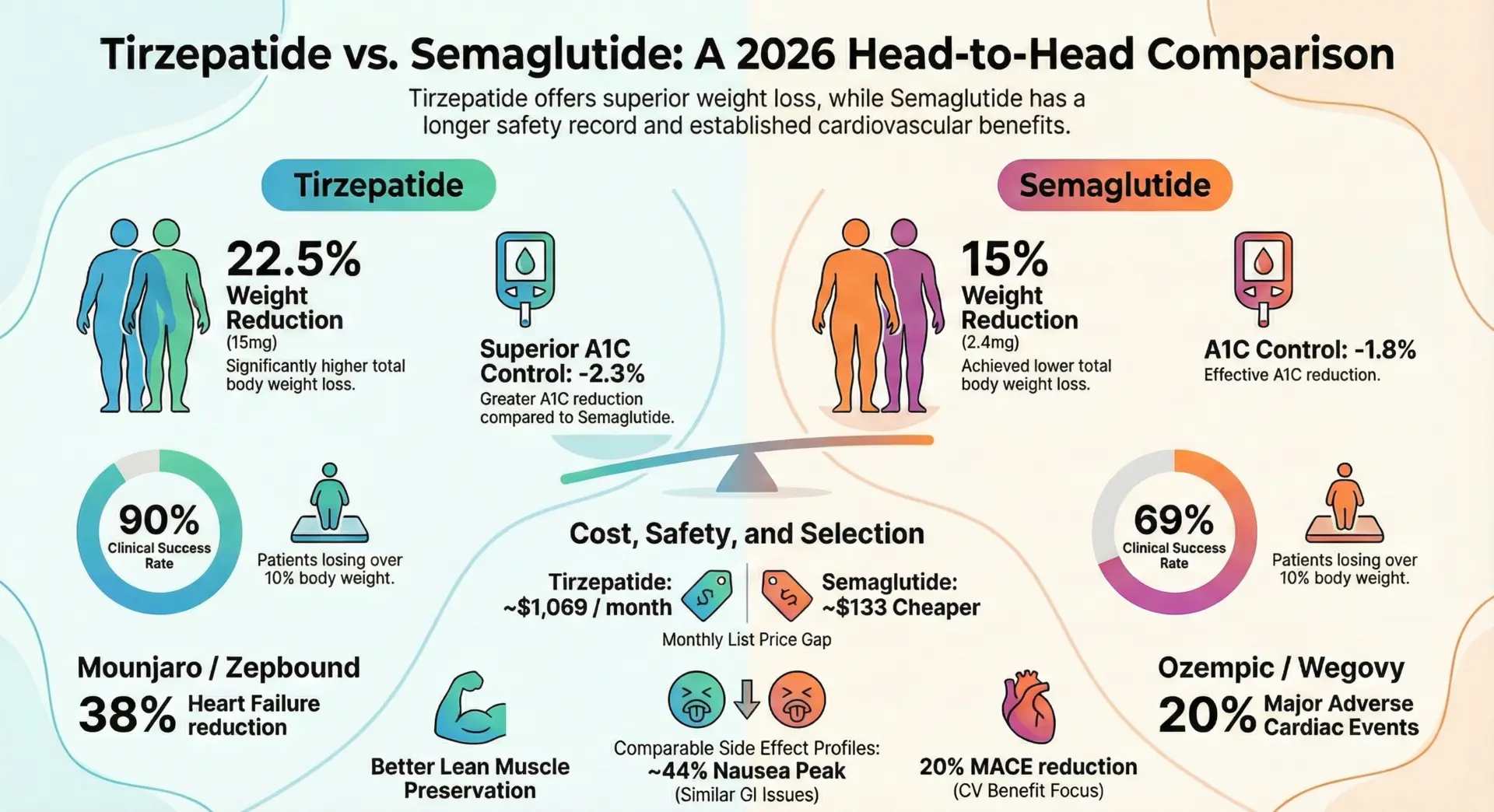

Tirzepatide outperforms semaglutide for weight loss and blood sugar control in most clinical settings. In the landmark SURPASS-2 trial published in the New England Journal of Medicine, tirzepatide at its highest dose (15 mg) achieved roughly double the weight reduction of semaglutide 1 mg at 40 weeks.
For chronic weight management in adults with obesity, tirzepatide 15 mg delivered a mean 22.5% body weight reduction in the SURMOUNT-1 trial, compared to approximately 15% with semaglutide 2.4 mg in the STEP trials.
That said, both medications are FDA-approved, effective treatments for obesity and type 2 diabetes and the ideal choice depends on individual patient factors.
TL;DR
- Tirzepatide is a dual GIP/GLP-1 receptor agonist manufactured by Eli Lilly, while semaglutide is a GLP-1 receptor agonist only, made by Novo Nordisk.
- In head-to-head clinical trials and real-world studies, tirzepatide consistently delivers greater weight loss (up to 22.5% vs 15%), superior A1C reduction (-2.3% vs -1.8%), and a higher proportion of patients achieving clinically meaningful weight loss thresholds.
- However, semaglutide has a longer safety record, proven 20% cardiovascular risk reduction from the SELECT trial, and costs roughly $133 less per month.
- Both medications share similar gastrointestinal side effects. Your best choice depends on whether you prioritize maximum weight loss (tirzepatide) or budget and cardiovascular data (semaglutide).
Head-to-Head Efficacy: Tirzepatide Wins 22% vs 15% Weight Loss
The most robust head-to-head comparison comes from the SURPASS-2 trial, a 40-week, phase 3 study of 1,879 adults with type 2 diabetes, published in the N Engl J Med. In this trial, tirzepatide at all three doses (5 mg, 10 mg, and 15 mg) achieved significantly greater weight loss compared to once weekly semaglutide 1 mg.
Patients receiving tirzepatide 15 mg lost an average of 12.4 kg (about 13.1% of baseline weight), roughly double the 6.2 kg (6.7%) seen with semaglutide. The standardized mean differences clearly favored tirzepatide across all treatment groups.
Key Efficacy Comparison
| Metric | Tirzepatide | Semaglutide | Winner |
| Weight Loss (Obesity) | 22.5% | ~15% | Tirzepatide |
| A1C Reduction | -2.3% | -1.8% | Tirzepatide |
| Weight Loss (T2D) | 12.4 kg | 6.2 kg | Tirzepatide |
| CV Risk Reduction | 38% HF events (SUMMIT) | 20% MACE (SELECT) | Different endpoints |
Year 1 Outcomes: For chronic weight management in adults without diabetes, tirzepatide 15 mg achieved a mean 22.5% total body weight reduction in SURMOUNT-1 (N Engl J Med, 2022), while semaglutide 2.4 mg delivered approximately 15% in the STEP program. A higher proportion of patients treated with tirzepatide achieved weight loss of 5% or greater (96% vs approximately 86%), 10% or greater (90% vs ~69%), and 15% or greater (78% vs ~50%). These results demonstrate that tirzepatide is associated with a higher percentage of patients achieving significant, clinically meaningful weight loss thresholds compared to semaglutide.
Real-World Evidence: A retrospective cohort study using electronic health record data found that tirzepatide was associated with a mean weight loss of 6.6 kg compared to 3.1 kg for semaglutide over a 6-month follow-up period.
The proportion of patients achieving greater than 5%, 10%, and 15% weight loss was significantly higher in the tirzepatide group compared to the semaglutide group. At 12 months, tirzepatide was associated with a greater mean weight loss of 14.7% compared to 10.8% for semaglutide. In patients without diabetes, tirzepatide provided an additional 3.6% weight loss compared to semaglutide, while in patients with diabetes, the percentage change in body weight was not statistically different between the two groups.
Dosing Comparison: 15 mg vs 2.4 mg Weekly
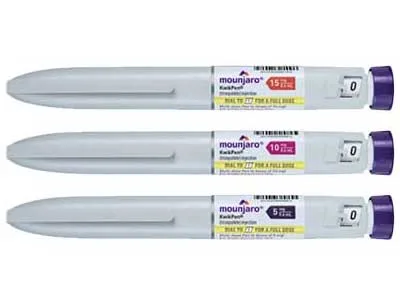
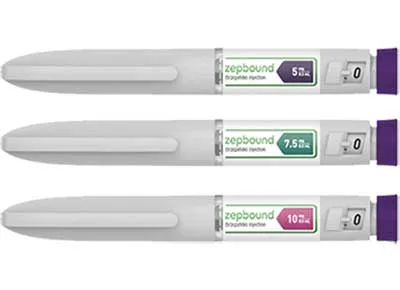
Both tirzepatide and semaglutide are administered via subcutaneous injection once weekly, but their dosing regimens differ significantly. Tirzepatide (sold as Mounjaro for T2D and Zepbound for obesity) starts at 2.5 mg and escalates in 2.5 mg increments every four weeks, up to a maximum of 15 mg. Semaglutide (sold as Ozempic for T2D at up to 2 mg and Wegovy for obesity at 2.4 mg) starts at 0.25 mg and takes about 16 weeks to reach its target dose. Tirzepatide has a faster ramp-up, typically reaching maximum dose in approximately 20 weeks.
| Drug | Brand(s) | Max Dose | Titration | Needle |
| Tirzepatide | Mounjaro / Zepbound | 15 mg | 4 weeks/step | 31G x 5 mm |
| Semaglutide | Wegovy / Ozempic | 2.4 mg | 16 weeks total | 32G x 4 mm |
Both medications are injected into the abdomen or thigh. Despite the difference in milligram amounts, each drug is calibrated to its own potency scale. The injection experience is largely comparable, with pre-filled pens designed for patient self-administration.
Cost Breakdown 2026: $1,069 vs $936
Without insurance, tirzepatide carries a higher list price than semaglutide. This pricing gap largely reflects tirzepatide being a newer medication with a dual-agonist patent, whereas semaglutide is a more established drug with potential generics on the horizon around 2028.
| Pricing | Tirzepatide | Semaglutide | Savings Tips |
| List (1-Month) | ~$1,069 | ~$936 | GoodRx: ~$850 vs ~$799 |
| Commercial Copay | $25 | $25 | Lilly / Novo savings cards |
| Compounding | ~$350 | ~$250 | Cash only, variable |
| At Pandameds.com | $559.99 | $599.95 | 10% Off on First Order |
For many patients with commercial insurance, manufacturer savings cards from Eli Lilly and Novo Nordisk can reduce the copay to as low as $25 per month. Compounded versions are available at lower prices, though they are not FDA-approved branded products. Patients should consult their provider and insurance plan to determine actual out-of-pocket costs.
Side Effects & Safety: GI Equal, Tirzepatide Muscle Loss Less
Both tirzepatide and semaglutide share similar, mostly gastrointestinal adverse events. Common issues include nausea, vomiting, diarrhea, and constipation, which are typically mild to moderate and most frequent during dose escalation. Nausea was reported at nearly identical rates (approximately 44%) for both drugs in comparative analyses.
| Side Effect | Tirzepatide | Semaglutide | Dropout Rate |
| Nausea Peak | Week 5 (~25%) | Week 8 (~28%) | 4.5% vs 5.2% |
| Lean Mass Impact | ~27% lean mass loss | ~40% lean mass loss | Tirzepatide better |
| Serious AEs | Pancreatitis ~0.1% | Gallbladder ~1.2% | Equivalent overall |
CVD Safety
Semaglutide has a well-established FDA approval for reducing the risk of major adverse cardiovascular events (MACE) in high-risk patients, based on the SELECT trial which demonstrated a 20% reduction in MACE over a mean 39.8-month follow-up.
Tirzepatide has emerging and strong cardiovascular data from the SUMMIT trial, which showed a 38% reduction in worsening heart failure events in patients with HFpEF and obesity. However, large-scale, long-term cardiovascular outcomes trials for tirzepatide are still ongoing.
A1C & T2D Control: Tirzepatide -2.3% vs -1.8%
For type 2 diabetes management, tirzepatide met superiority over semaglutide across all doses in the SURPASS-2 trial. The mean A1C reduction from a baseline of 8.28% was -2.01% (5 mg), -2.24% (10 mg), and -2.30% (15 mg) with tirzepatide versus -1.86% with semaglutide 1 mg.
Up to 92% of patients on tirzepatide achieved the ADA-recommended A1C target of less than 7%, compared to 81% on semaglutide. Remarkably, up to 51% of tirzepatide-treated patients reached an A1C below 5.7%, a level reflecting near-normal glycemia.
Fasting glucose reductions also favored tirzepatide (approximately -68 mg/dL vs -59 mg/dL). Both medications enhanced insulin secretion and reduced appetite, but tirzepatide’s dual action on GIP and GLP-1 pathways provides broader metabolic benefits including improved lipid profiles, blood pressure, and biomarkers of insulin sensitivity. Hypoglycemia rates remained low with both drugs.
Weight Loss Specific Brands: Mounjaro vs Wegovy/Ozempic
| Indication | Tirzepatide Brand | Semaglutide Brand | Year 1 Weight Loss |
| Type 2 Diabetes | Mounjaro | Ozempic | ~22% vs ~14% |
| Obesity/Overweight | Zepbound | Wegovy | ~22% vs ~15% |
Mounjaro was FDA-approved in May 2022 for adults with type 2 diabetes, while Zepbound received approval in November 2023 for chronic weight management. Ozempic is approved for T2D, and Wegovy is approved for obesity. Off-label prescribing of Ozempic for weight loss remains common, though Wegovy is the formally indicated version. Compounded semaglutide options at approximately $250/month have gained popularity, though these lack the branded product’s regulatory oversight.
Patient Selection Matrix: Which Is Better for You?
| Priority | Best Choice | Why |
| Max Weight Loss | Tirzepatide | +7% absolute advantage over semaglutide |
| Budget / Established T2D | Semaglutide | ~$133 cheaper, stable supply, longer track record |
| Heart Failure (HFpEF) | Tirzepatide | 38% reduction in HF events (SUMMIT trial) |
| Muscle Preservation | Tirzepatide | ~27% lean mass loss vs ~40% with semaglutide |
| Proven CV Protection | Semaglutide | 20% MACE reduction (SELECT trial, FDA-approved) |
SGLT2 vs Dual Agonists: Putting Weight Loss in Context
SGLT2 inhibitors like empagliflozin (Jardiance) offer modest weight reduction of approximately 4 to 6 pounds, a fraction of what dual agonists deliver. Tirzepatide’s mean 52-pound loss at its highest dose dwarfs this class.
However, SGLT2 inhibitors provide independent cardiovascular and renal benefits, leading to an emerging combination strategy. Some clinicians are exploring the use of SGLT2 inhibitors alongside GLP-1 or dual GIP/GLP-1 receptor agonists to maximize metabolic outcomes. Future study and future work in this area may clarify optimal combination approaches for patients with obesity and type 2 diabetes.
References & Sources
- SURPASS-2 Trial (N Engl J Med)
- SURMOUNT-1 Trial (N Engl J Med)
- SELECT Trial – Semaglutide CV Outcomes (N Engl J Med)
- SUMMIT Trial – Tirzepatide HFpEF (N Engl J Med)
- Eli Lilly SURPASS-2 Results (Press Release)
- Eli Lilly SURMOUNT-1 Results (Press Release)
- ADA SURPASS Data Presentation
- SUMMIT Trial – ACC Summary
- SELECT Trial – ACC Summary
Disclaimer: This information is intended for general knowledge and informational purposes only and does not constitute medical advice. Always consult with a healthcare professional for personalized guidance.
Written by the Pandameds.com Editorial Team
Our content is created by pharmacy-trained researchers and healthcare specialists and rigorously reviewed by a diverse panel of authentic experts from the pharmaceutical and healthcare fields. This collaborative review process ensures that every article meets the highest standards of medical accuracy, reliability, and relevance.
- ✅ Authored by pharmacy-trained professionals
- 🔍 Reviewed by multiple verified experts in the pharmaceutical and healthcare niche
- 💊 Based on trusted sources including FDA, Health Canada, and peer-reviewed clinical studies
- 🔄 Regularly reviewed and updated every 90 days to maintain accuracy and trustworthiness
About Pandameds.com
Pandameds.com offers a range of weight loss medications at an affordable price.
Fast, Reliable Shipping to the USA!
Affordable Prescription Meds From Canada




Join our mailing list for exclusive promos, curated health content & more.
Related Blog Posts
Call Us Today!
If you have any questions, please email our support team at support@pandameds.com or call us toll-free at 1-888-862-1210.