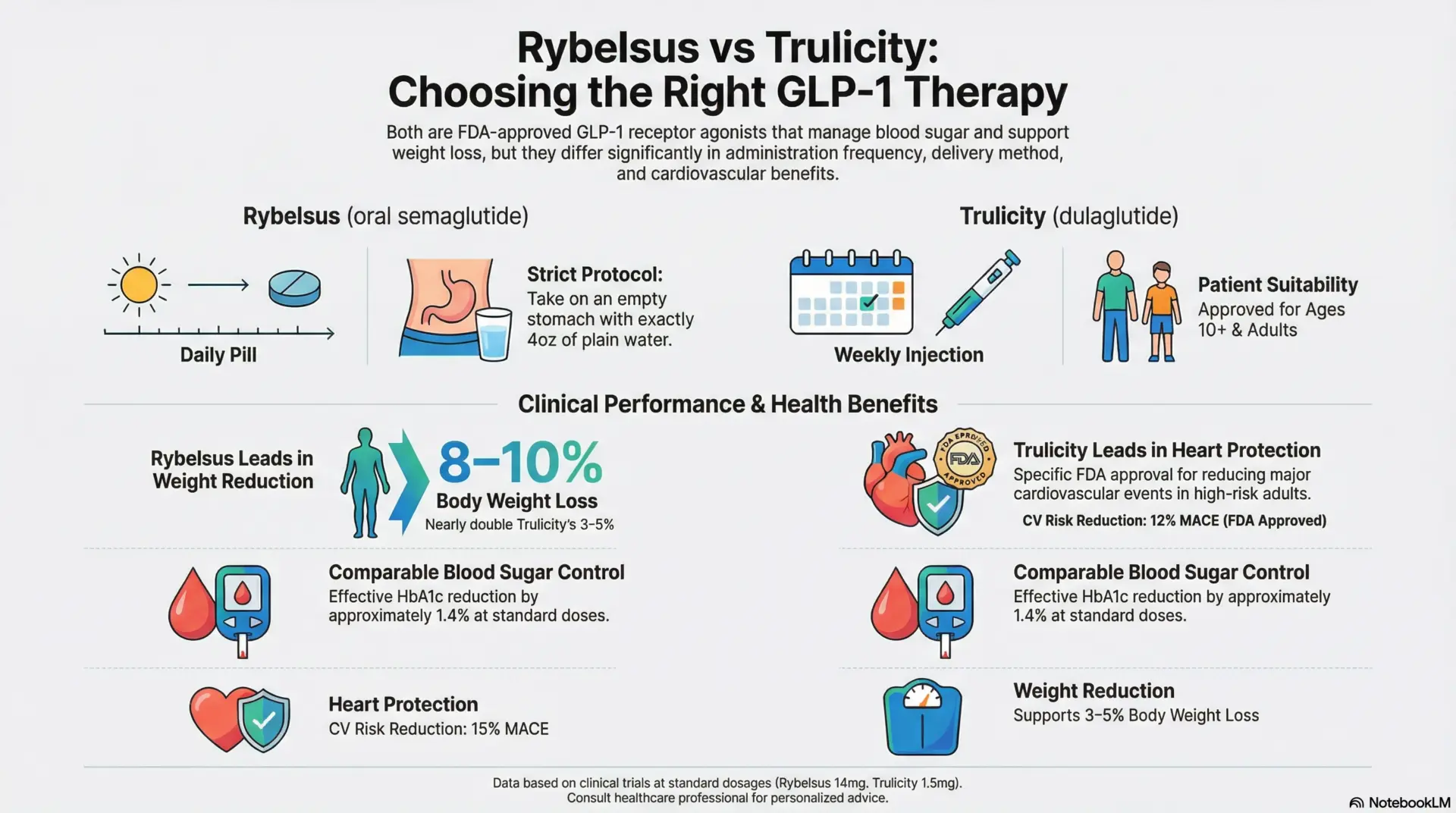

Rybelsus and Trulicity are both FDA-approved GLP-1 receptor agonists that help regulate blood sugar levels in patients with type 2 diabetes, but they differ significantly in administration: Rybelsus is the first oral semaglutide (taken as a daily pill), while Trulicity (dulaglutide) requires a weekly injection.
Clinical evidence from the PIONEER and REWIND trials demonstrates that both medications effectively lower HbA1c by approximately 1.4% while supporting weight management.
However, Rybelsus may lead to greater weight loss (8-11% body weight reduction) compared to Trulicity (3-5%), while Trulicity has specific FDA approval for cardiovascular risk reduction in adults with established cardiovascular disease or multiple cardiovascular risk factors.
TL;DR
- Rybelsus (oral semaglutide) and Trulicity (dulaglutide) are both GLP-1 receptor agonists used to manage type 2 diabetes and support weight loss.
- Rybelsus is a once-daily pill taken on an empty stomach, while Trulicity is a once-weekly subcutaneous injection.
- In clinical trials, Rybelsus showed superior weight loss (8-10% body weight reduction) and comparable A1C reductions of 1.4-1.8%.
- Trulicity offers FDA-approved cardiovascular risk reduction and is approved for pediatric patients aged 10 and older.
- Both medications cost approximately $900-1,000 monthly without insurance.
- Choose Rybelsus if you prefer oral medication; choose Trulicity for weekly convenience and established cardiovascular disease protection.
Mechanism of Action: Oral vs Weekly GLP-1
Both Rybelsus and Trulicity belong to the GLP-1 receptor agonists class, mimicking the natural incretin hormone glucagon-like peptide-1.
These medications work by stimulating insulin release when blood sugar levels are elevated, reducing glucagon secretion to prevent excess glucose production and slowing gastric emptying to promote steady blood sugar control.
Additionally, they reduce appetite by signaling fullness to the brain, which supports weight loss efforts alongside diet and exercise.
Rybelsus (Oral Semaglutide)
Rybelsus contains semaglutide as its active ingredient and is often referred to as ‘Ozempic in pill form’ because it shares the same compound. It is the first FDA-approved oral GLP-1 receptor agonist, using a co-formulation with the absorption enhancer SNAC to enable stomach absorption.
Rybelsus is taken once daily in tablet form on an empty stomach with no more than 4 ounces of water, and patients must wait at least 30 minutes before eating or taking other medications.
The oral formulation boosts incretin activity by approximately 40%, slows gastric emptying, and initiates appetite suppression within the first week.
According to the American Journal of Managed Care, the PIONEER clinical program demonstrated that Rybelsus provides effective glycemic control across patients at different disease stages.
Trulicity (Dulaglutide)
Trulicity contains dulaglutide as its active ingredient and is administered as a once-weekly subcutaneous injection in the stomach area, thigh, or upper arm.
As a long-acting GLP-1 analog, Trulicity is bound to albumin, giving it an extended half-life of approximately 5 days that maintains steady-state insulin secretion throughout the week.
Trulicity is specifically FDA-approved for pediatric patients aged 10 years and older with type 2 diabetes, unlike Rybelsus which is approved only for adults. The weekly injection format provides baseline glycemic stability while Rybelsus peaks for post-meal blood sugar control.
According to data from the REWIND cardiovascular outcomes trial, Trulicity demonstrated a 12% reduction in major cardiovascular events over 5+ years of follow-up.
Efficacy Comparison Table
The PIONEER 10 trial directly compared oral semaglutide with dulaglutide in Japanese adults with type 2 diabetes over 52 weeks.
| Metric | Rybelsus 14mg | Trulicity 1.5mg | Winner | Trial |
| A1C Reduction | 1.4-1.8% | 1.2-1.5% | Rybelsus | PIONEER 2 |
| Weight Loss (Year 1) | 8-10% (8-9kg) | 3-5% (4kg) | Rybelsus | PIONEER/AWALD |
| Fasting Glucose | -49 mg/dL | -38 mg/dL | Rybelsus | SUSTAIN |
| CV Risk Reduction | 15% MACE | 12% MACE | Trulicity | REWIND |
| Hypoglycemia Risk | <2% | <3% | Comparable | PIONEER/REWIND |
Note: At maximum doses (Trulicity 4.5mg), A1C reduction increases to 1.8%, making efficacy more comparable. Rybelsus edges out Trulicity in A1C and weight metrics at standard doses, while Trulicity provides superior CV composite endpoint protection based on the REWIND trial data published in The Lancet.
Rybelsus vs Trulicity Weight Loss
The PIONEER-1 trial found that participants taking Rybelsus experienced a weight loss of approximately 2.6 kg (~5.7 lbs) after 26 weeks with monotherapy. In the PIONEER 4 trial, patients adding Rybelsus 14mg to metformin lost an average of 4.4 kg (9.7 lbs) over 26 weeks.
Rybelsus achieves 8-11% sustained body weight reduction via stronger appetite suppression, with weight loss typically peaking around month 6. Trulicity provides modest weight loss of 4-6%, with plateaus occurring earlier. Some studies indicate that combining either medication with metformin can enhance total weight loss to approximately 12%.
While Rybelsus is FDA-approved for type 2 diabetes management, it is sometimes used off-label for weight management due to its weight loss benefits.
Higher investigational doses (25mg and 50mg) in the PIONEER PLUS trial showed weight reductions of approximately 10% body weight, approaching levels seen with injectable weight-loss medications.
Side Effects Head-to-Head
According to clinical trial data from the FDA, side effects occurred in 77-85% of Rybelsus users and 82% of Trulicity users. About 3-6% of participants in clinical trials for both medications stopped treatment early due to side effects.
| Side Effect | Rybelsus Rate | Trulicity Rate | Peak Timeline | Management |
| Nausea | 25-35% | 20-25% | Week 4 | Slow titration |
| Vomiting | 10% | 8% | Week 2-6 | Anti-nausea medication |
| Diarrhea | 15% | 12% | Ongoing | Probiotics, hydration |
| Decreased Appetite | Common | Common | Week 1-2 | Expected effect |
| Injection Site Reaction | 0% | 5% | First dose | Rotate sites |
| Abdominal Pain | 10-15% | 8-12% | Week 2-4 | Smaller meals |
Both Rybelsus and Trulicity carry serious warnings for thyroid tumors and thyroid c cell tumors. They are contraindicated in patients with a personal or family history of medullary thyroid cancer or multiple endocrine neoplasia syndrome type 2. For detailed prescribing information, refer to the official Rybelsus prescribing information.
Cost Comparison 2026
According to GoodRx pricing data, the list price for Rybelsus is around $997.58 for a month’s supply, while Trulicity costs approximately $987.19 per month when purchased out of pocket.
| Cost Factor | Rybelsus (Monthly) | Trulicity (Monthly) | Savings Options |
| List Price | $936-1,000 (30 tabs) | $850-987 (4 pens) | Manufacturer cards available |
| Annual Cost | ~$11,232 | ~$10,200 | 12 months eligible for savings |
| With Savings Card | As low as $10-25/month | As low as $25/month | Commercial insurance required |
| Insurance Coverage | 99% commercial plans | Most commercial plans | Prior auth often required |
Trulicity is approximately 9% cheaper at list price, but both medications offer equivalent copay access through manufacturer savings programs.
Patients may qualify for Patient Assistance Programs to receive these medications at reduced or no cost. Both manufacturers offer savings cards and coupons to help with affordability.
Dosing & Administration Guide
Rybelsus Titration
Rybelsus is taken as a once-daily oral tablet. The starting dose is 3 mg taken for the first month, which is then increased to 7 mg in the second month, and can be further increased to the maximum dose of 14 mg thereafter based on glycemic response and tolerability.
The medication must be taken on an empty stomach with no more than 4 ounces of plain water, and patients should wait at least 30 minutes before eating, drinking anything else, or taking other medications.
If a dose is missed by more than 10 hours, skip it and resume the next scheduled dose.
Trulicity Schedule
Trulicity is administered as a once-weekly subcutaneous injection.
Trulicity starting dose is 0.75 mg once weekly for the first month, which can be increased to 1.5 mg in the second month, and further increased in 1.5 mg increments up to a maximum dose of 4.5 mg weekly based on therapeutic response.
The weekly injection can be administered in the stomach area, thigh, or upper arm at any time of day, with or without meals. This once-weekly injection schedule offers convenience with fewer medication reminders compared to a daily pill. For complete dosing instructions, consult the official Trulicity prescribing information.
Patient Selection: Rybelsus vs Trulicity for T2D
Rybelsus Best For:
Patients who are injection-phobic or strongly prefer oral medications, those requiring precise postprandial (after-meal) blood sugar control, and adults with BMI over 30 seeking enhanced weight loss support. Rybelsus is ideal for patients who can reliably take medication on an empty stomach each morning.
Avoid in: Patients with gastroparesis or structural abnormalities of the gastrointestinal tract, as slow digestion may affect absorption.
Trulicity Best For:
Patients who prefer once-weekly convenience over daily dosing, those with established cardiovascular disease or multiple cardiovascular risk factors seeking FDA-approved cardiovascular risk reduction, patients with adherence challenges who benefit from less frequent dosing, and pediatric patients aged 10 years and older.
Avoid in: Patients with a family history of medullary thyroid cancer or personal history of thyroid tumors.
Key Clinical Trial Data
The PIONEER program for oral semaglutide (Rybelsus) included over 10,000 adults with type 2 diabetes across multiple studies. PIONEER 2 (n=816) demonstrated Rybelsus achieved superior A1C reductions of 1.4-1.5% compared to comparator medications. PIONEER 10 directly compared Rybelsus vs Trulicity, showing Rybelsus 14mg lowered HbA1c by 1.7% versus 1.4% with Trulicity 0.75mg over 52 weeks.
The REWIND trial (n=9,901) was a landmark cardiovascular outcomes trial for Trulicity. Over a median follow-up of 5.4 years, Trulicity demonstrated a 12% reduction in major adverse cardiovascular events (MACE) including heart attack, stroke, and cardiovascular death.
References & Sources
Disclaimer: This information is intended for general knowledge and informational purposes only and does not constitute medical advice. Always consult with a healthcare professional for personalized guidance.
Written by the Pandameds.com Editorial Team
Our content is created by pharmacy-trained researchers and healthcare specialists and rigorously reviewed by a diverse panel of authentic experts from the pharmaceutical and healthcare fields. This collaborative review process ensures that every article meets the highest standards of medical accuracy, reliability, and relevance.
- ✅ Authored by pharmacy-trained professionals
- 🔍 Reviewed by multiple verified experts in the pharmaceutical and healthcare niche
- 💊 Based on trusted sources including FDA, Health Canada, and peer-reviewed clinical studies
- 🔄 Regularly reviewed and updated every 90 days to maintain accuracy and trustworthiness
About Pandameds.com
Pandameds.com offers a range of weight loss medications at an affordable price.
Fast, Reliable Shipping to the USA!
Affordable Prescription Meds From Canada




Join our mailing list for exclusive promos, curated health content & more.
Frequently Asked Questions
Which is better for weight loss?
Rybelsus generally produces greater weight loss, with studies showing 8-10% body weight reduction compared to Trulicity's 4-6%. This difference is attributed to Rybelsus's stronger appetite suppression effects.
Rybelsus vs Trulicity: Which has better A1C reduction?
Both medications provide similar A1C reductions of approximately 1.4% on average. Rybelsus may show slightly faster onset with effects visible by week 4, while Trulicity at higher doses (3-4.5mg) can achieve reductions up to 1.8%. At maximum doses, both are comparably effective for blood sugar control.
Oral vs injection GLP-1: Which should I choose?
Choose Rybelsus if you are needle-averse and can reliably take a daily pill on an empty stomach. Choose Trulicity if you prefer the convenience of once-weekly dosing and don't mind injections. The injectable medication (Trulicity) requires fewer medication reminders, while the oral option (Rybelsus) eliminates injection-related concerns.
Which has worse side effects?
Rybelsus has a higher peak nausea rate (25-35% vs 20-25%) due to daily dosing and the gastrointestinal absorption process. However, side effects nausea, vomiting, and diarrhea typically resolve by month 3 for both medications. Trulicity has injection site reactions in about 5% of users that Rybelsus users don't experience.
What is the cost without insurance for Rybelsus vs Trulicity?
Trulicity is slightly cheaper at approximately $850-987 per month compared to Rybelsus at $936-1,000 per month. However, manufacturer savings cards can reduce both to as little as $10-25 per month for commercially insured patients. Contents save by comparing pharmacy prices and utilizing available coupons and Patient Assistance Programs.
Related Blog Posts
Call Us Today!
If you have any questions, please email our support team at support@pandameds.com or call us toll-free at 1-888-862-1210.