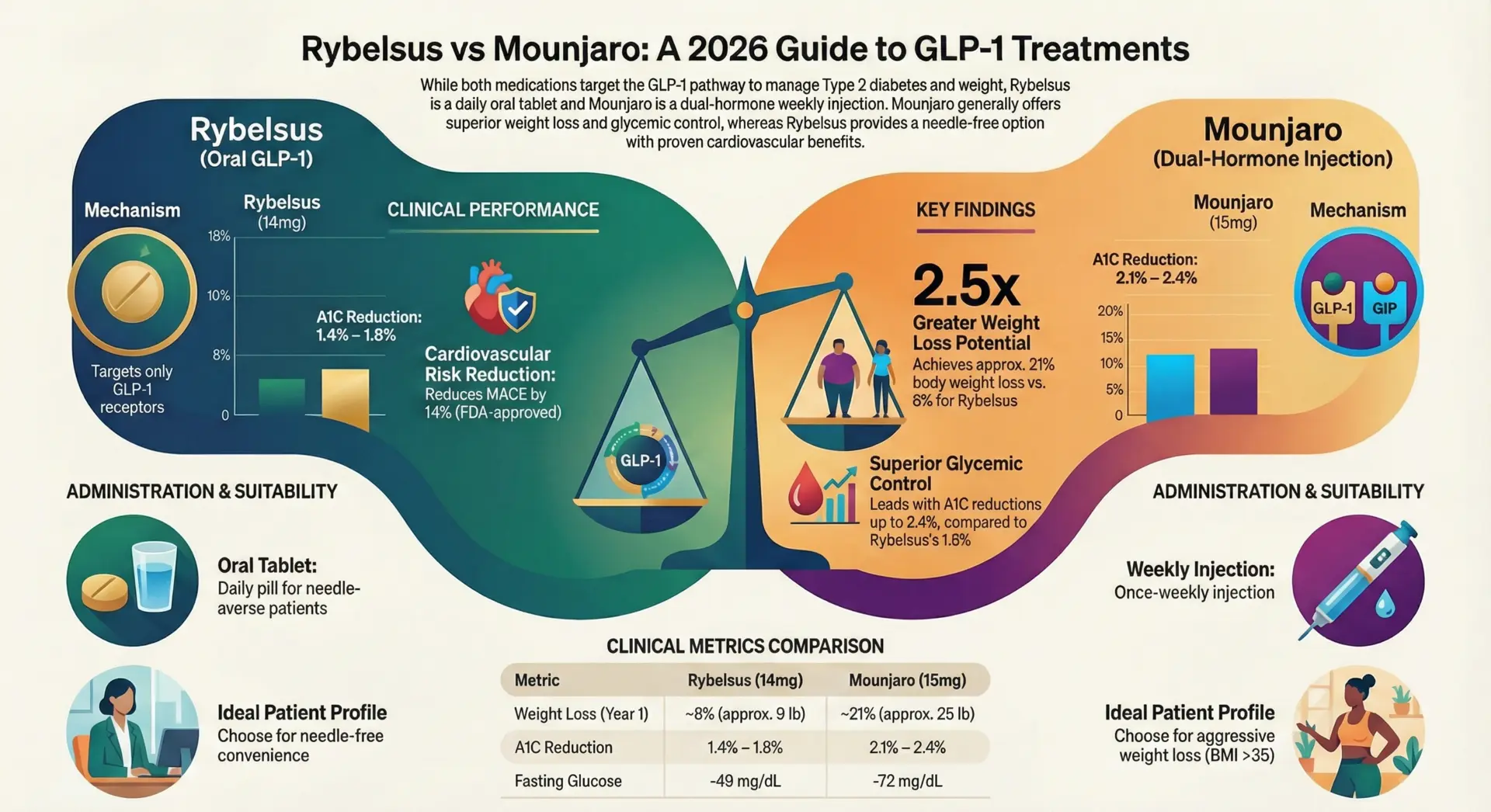

The fundamental difference lies in their receptor targeting: Rybelsus activates only GLP-1 receptors, while Mounjaro works as a dual agonist targeting both glucose-dependent insulinotropic polypeptide (GIP) and GLP-1 receptors. This dual hormone therapy approach gives Mounjaro distinct advantages in clinical efficacy.
Head-to-head data from the SURPASS-2 trial published in the New England Journal of Medicine demonstrates Mounjaro’s superiority: A1C reductions of -2.3% versus -1.9% for semaglutide, plus approximately three times greater weight loss (22 lb vs 7 lb at comparable doses).
However, Rybelsus holds a critical advantage as the first and only oral GLP-1 receptor agonist, eliminating the need for injections and offering a needle-free option for patients who prefer oral medications.
TL;DR
- Mounjaro (tirzepatide) delivers superior results compared to Rybelsus (oral semaglutide) for both blood sugar control and weight loss.
- In the landmark SURPASS-2 clinical trial, Mounjaro achieved A1C reductions of up to 2.3% versus 1.9% for injectable semaglutide, while producing approximately 2.5 times greater weight loss (12.4 kg vs 6.2 kg).
- Rybelsus offers the unique advantage of being the only oral GLP-1 medication, taken daily as a pill, whereas Mounjaro requires weekly injections.
- Cost-wise, Rybelsus lists at approximately $997/month while Mounjaro costs around $1,069/month, though savings programs can reduce both to as low as $25 for eligible patients.
- Both medications are FDA-approved for type 2 diabetes, carry similar gastrointestinal side effect profiles, and include black-box warnings for thyroid C-cell tumor risk.
Mechanism: GLP-1 Pill vs Dual GIP/GLP-1 Injection
Rybelsus (Oral Semaglutide)
Rybelsus contains the active ingredient semaglutide formulated with SNAC (salcaprozate sodium), an absorption enhancer that enables oral delivery. As a GLP-1 receptor agonist, it works by mimicking the natural incretin hormone GLP-1 to increase insulin secretion in a glucose-dependent manner, suppress glucagon release, slow gastric emptying by approximately 35%, and reduce appetite through central nervous system signaling.
The medication is available in 3 mg, 7 mg, and 14 mg tablets taken once daily on an empty stomach with no more than 4 oz of water, followed by a 30-minute fast before eating or taking other medications.
Mounjaro (Tirzepatide)
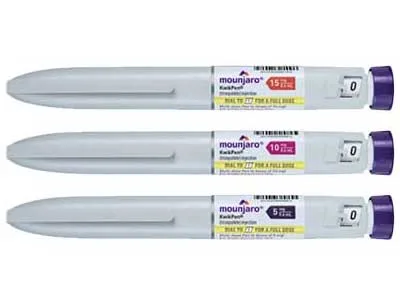
Mounjaro’s active ingredient, tirzepatide, is a first-in-class dual GIP and GLP-1 receptor agonist administered via once-weekly subcutaneous injection. The FDA approved Mounjaro in May 2022 as the first medication to target both incretin hormone pathways. GIP activation enhances fat metabolism and provides additional appetite suppression through the brain’s hunger control centers, while GLP-1 activity delivers satiety signals, with clinical studies showing up to 57% hunger reduction by week 4.
Available doses of medication range from 2.5 mg to 15 mg, with the dual receptor mechanism explaining Mounjaro’s approximately 2.5-fold greater potency for weight loss compared to single-receptor GLP-1 medications.
Efficacy Comparison Table
Clinical trial data from the PIONEER program (Rybelsus) and SURPASS program (Mounjaro) provide a lot of evidence for comparing these medications:
| Metric | Rybelsus 14mg | Mounjaro 15mg | Winner | Trial Source |
| A1C Reduction | 1.4-1.8% | 2.1-2.4% | Mounjaro | SURPASS-2 |
| Weight Loss (Y1) | ~8% (9 lb) | ~21% (25 lb) | Mounjaro | SURMOUNT-1 |
| Fasting Glucose | -49 mg/dL | -72 mg/dL | Mounjaro | SURPASS |
| CV Risk Reduction | 14% MACE | Pending | Rybelsus | SOUL Trial |
| Hypoglycemia | <2% | <1% | Tie | Both Programs |
Mounjaro dominates across glycemic control and weight loss metrics, while Rybelsus leads with proven cardiovascular data from the SOUL trial.
Rybelsus vs Mounjaro Weight Loss
The weight loss differences between these medications are substantial. Mounjaro achieves approximately 21% body weight loss after one year at the highest dose, compared to about 8% with Rybelsus 14 mg.
This significant difference stems from Mounjaro’s dual mechanism: GIP-mediated fat oxidation combined with GLP-1 satiety effects creates more pronounced and sustained weight reduction.
In the SURPASS-2 head-to-head trial, patients on Mounjaro 15 mg lost an average of 12.4 kg (approximately 27 lb) compared to 6.2 kg (about 14 lb) with semaglutide 1 mg injection over 40 weeks. Notably, weight loss had not plateaued at study end in any treatment group, suggesting continued benefits with longer treatment duration. While Rybelsus weight loss tends to plateau around month 6,
Mounjaro sustains losses exceeding 15% through 72 weeks of treatment. Both medications are used off-label for weight management in patients without diabetes, though insurance coverage varies significantly for this indication.
Side Effects Comparison
Both Rybelsus and Mounjaro share common side effects typical of the GLP-1 receptor agonist class. The most common side effects are gastrointestinal, including nausea, vomiting, abdominal pain, decreased appetite, diarrhea, and constipation.
According to FDA prescribing information, approximately 20% of participants experience gastrointestinal side effects with either medication, while 60-75% of patients report at least one adverse event of any type.
| Side Effect | Rybelsus | Mounjaro | Peak Timeline | Management |
| Nausea | 25-35% | 25-30% | Week 4 | Slow titration |
| Diarrhea | 15% | 20% | Week 5-8 | Imodium PRN |
| Vomiting | 10% | 12% | Titration | Anti-emetics |
| Constipation | 10% | 15% | Ongoing | Fiber, Miralax |
| Injection Site | 0% (oral) | 3% | First doses | Rotate sites |
Both medications carry a black-box warning for thyroid C-cell tumors, including medullary thyroid carcinoma, and are contraindicated in patients with personal or family history of MTC or Multiple Endocrine Neoplasia syndrome type 2.
Other serious but rare side effects include pancreatitis, gallbladder issues, kidney problems, and allergic reactions. Severe adverse events interfering with daily activities occur in approximately 3% of Rybelsus patients and 5.7% of Mounjaro patients at maximum doses.
Cost Comparison 2026
| Pricing | Rybelsus | Mounjaro |
| List Price/Month | ~$997 | ~$1,069 |
| Annual List | ~$11,970 | ~$12,828 |
| With Savings Card | As low as $25 | As low as $25 |
| Pandameds.com | $298.00 | $559.99 |
Dosing & Administration Guide
Rybelsus Titration
Rybelsus requires specific administration for optimal absorption. Take the tablet daily on an empty stomach with no more than 4 oz (120 mL) plain water, then wait at least 30 minutes before eating, drinking, or taking other oral medications.
Dosage begins at 3 mg daily for 30 days, then increases to 7 mg daily for at least 30 days, with potential escalation to 14 mg if additional glycemic control is needed. Patients should not split, crush, or chew tablets. If a dose is missed by more than 10 hours, skip that dose and resume the following day.
Mounjaro Schedule
Mounjaro is injected subcutaneously once weekly in the abdomen, thigh, or upper arm, at any time of day with or without food.
The titration schedule begins at 2.5 mg weekly for 4 weeks, then escalates through 5 mg, 7.5 mg, 10 mg, and 12.5 mg at 4-week intervals as tolerated, up to a maximum maintenance dose of 15 mg. Patients can change their injection day if needed, ensuring at least 3 days between doses.
Patient Selection: Rybelsus vs Mounjaro
Rybelsus is best suited for:
Patients who are needle-phobic or strongly prefer oral medications; those seeking precise postprandial glucose control; individuals with mild-to-moderate type 2 diabetes (A1C 7-9%); and patients prioritizing proven cardiovascular risk reduction (now FDA-approved for MACE reduction). Rybelsus should be avoided in patients with severe gastroparesis.
Mounjaro is best suited for:
Patients where obesity is a primary concern (BMI >35); those with higher baseline A1C (>9%) requiring maximum glycemic control; individuals targeting aggressive weight loss goals (>15% body weight); and patients comfortable with weekly injections who prefer less frequent dosing.
Pioneer vs Surpass Clinical Trial Data
The PIONEER program evaluated oral semaglutide in over 9,500 patients across multiple trials. PIONEER 1 demonstrated that Rybelsus 14 mg reduced A1C by 1.4% versus placebo over 26 weeks, with body weight reductions of 2.3-2.6 kg.
The SOUL cardiovascular outcomes trial (n=9,650) demonstrated a 14% relative risk reduction in major adverse cardiovascular events with oral semaglutide 14 mg versus placebo over approximately 4 years.
The SURPASS program enrolled over 19,000 participants with type 2 diabetes. In the pivotal SURPASS-2 trial (n=1,879), tirzepatide at all doses (5 mg, 10 mg, 15 mg) demonstrated both non-inferiority and superiority to semaglutide 1 mg injection for A1C reduction (-2.01% to -2.30% vs -1.86%) and body weight loss (-7.6 to -12.4 kg vs -5.7 kg). Meta-analysis confirms tirzepatide’s dual-action superiority across glycemic and weight endpoints.
Sources
- Tirzepatide versus Semaglutide Once Weekly in Patients with Type 2 Diabetes. N Engl J Med. 2021
- FDA Mounjaro Prescribing Information 2025
- FDA Rybelsus Prescribing Information 2025
- Tirzepatide – StatPearls – NCBI Bookshelf
- Semaglutide – StatPearls – NCBI Bookshelf
- PIONEER 1 Trial – Diabetes Care 2019
- Lilly SURPASS-2 Press Release
- FDA Approves Oral Semaglutide for CV Risk Reduction – AJMC
Disclaimer: This information is intended for general knowledge and informational purposes only and does not constitute medical advice. Always consult with a healthcare professional for personalized guidance.
Written by the Pandameds.com Editorial Team
Our content is created by pharmacy-trained researchers and healthcare specialists and rigorously reviewed by a diverse panel of authentic experts from the pharmaceutical and healthcare fields. This collaborative review process ensures that every article meets the highest standards of medical accuracy, reliability, and relevance.
- ✅ Authored by pharmacy-trained professionals
- 🔍 Reviewed by multiple verified experts in the pharmaceutical and healthcare niche
- 💊 Based on trusted sources including FDA, Health Canada, and peer-reviewed clinical studies
- 🔄 Regularly reviewed and updated every 90 days to maintain accuracy and trustworthiness
About Pandameds.com
Pandameds.com offers a range of weight loss medications at an affordable price.
Fast, Reliable Shipping to the USA!
Affordable Prescription Meds From Canada




Join our mailing list for exclusive promos, curated health content & more.
Frequently Asked Questions
Which is better for weight loss?
Mounjaro is significantly more effective for weight loss, achieving approximately 21% body weight reduction versus 8% with Rybelsus (roughly 2.5x greater). SURPASS-2 data shows Mounjaro 15 mg produces nearly double the weight loss of semaglutide injection, making it the preferred choice when weight management is the primary goal.
Rybelsus vs Mounjaro A1C reduction?
Mounjaro delivers superior A1C reductions: up to 2.3-2.4% versus 1.4-1.8% for Rybelsus. Both medications provide excellent blood sugar control, but Mounjaro's dual GIP/GLP-1 mechanism produces more pronounced glycemic improvements, with over 90% of patients at highest doses achieving A1C <7%.
Oral vs injection GLP-1 preference?
Rybelsus offers needle-free daily oral dosing, ideal for injection-averse patients who prioritize convenience. Mounjaro provides maximum efficacy with once-weekly injections using autoinjector pens. Patient preference, lifestyle factors, and treatment goals should guide this decision in consultation with a healthcare provider.
Are Mounjaro side effects worse than Rybelsus?
The side effect profiles are similar, with gastrointestinal symptoms being most common for both. Mounjaro may show slightly higher rates at maximum doses (nausea ~30% at 15 mg), while Rybelsus daily dosing may provide a tolerability edge through more gradual drug exposure. Both medications become better tolerated after the initial titration period.
Related Blog Posts
Call Us Today!
If you have any questions, please email our support team at support@pandameds.com or call us toll-free at 1-888-862-1210.