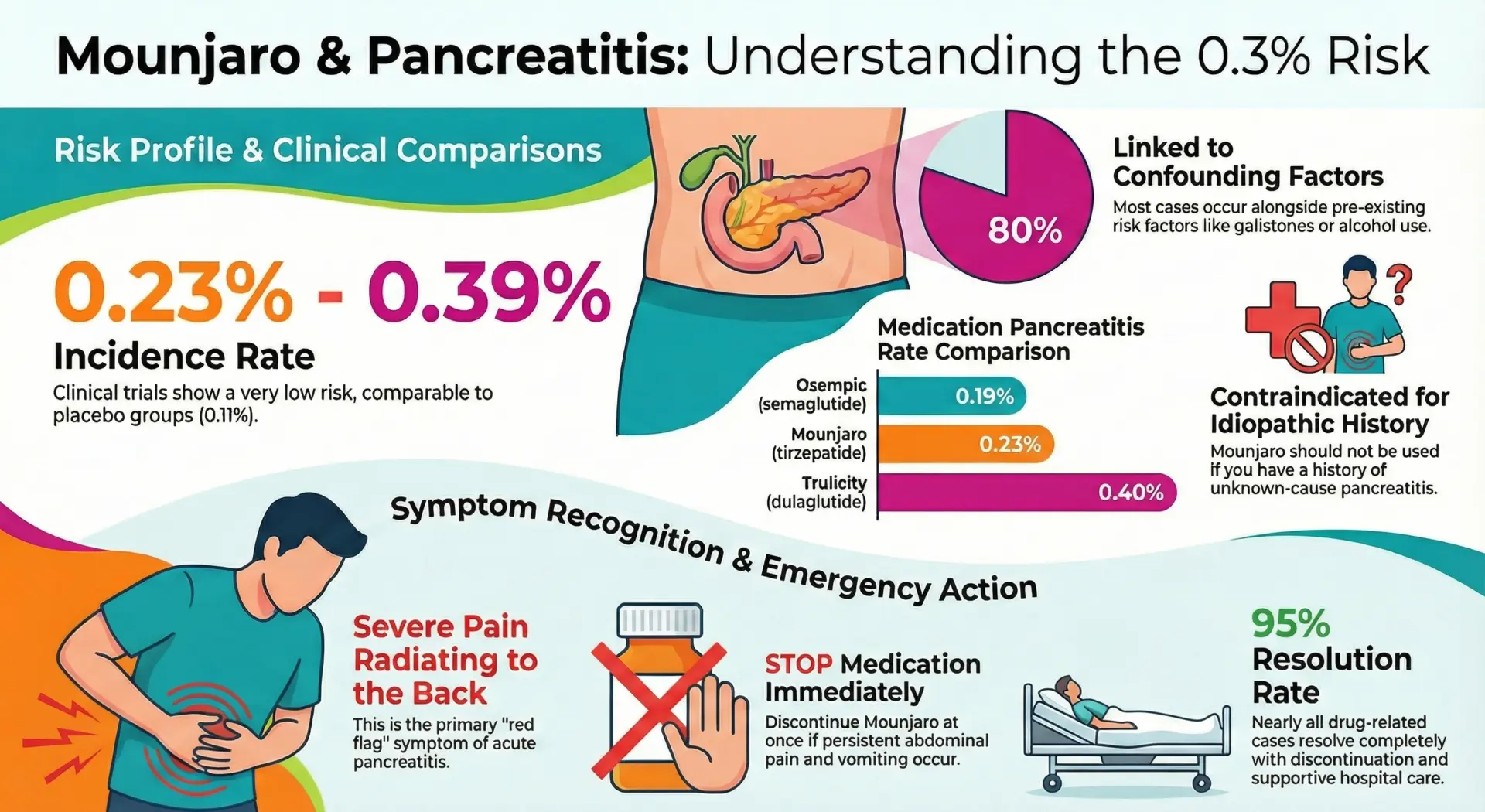

Yes, but rarely. Clinical trials show a 0.23-0.39% incidence rate for acute pancreatitis among patients treated with tirzepatide, similar to placebo groups. Mounjaro, manufactured by Eli Lilly, is a dual glucose-dependent insulinotropic peptide (GIP) and GLP-1 receptor agonist approved for managing type 2 diabetes mellitus and obesity.
According to the FDA prescribing information, patients should stop Mounjaro immediately and seek emergency care if they experience severe, persistent abdominal pain that may radiate to the back, accompanied by nausea and vomiting.
TL;DR
- Mounjaro (tirzepatide) carries a low pancreatitis risk of approximately 0.23-0.39% in clinical trials, comparable to placebo.
- The UK Medicines and Healthcare Products Regulatory Agency (MHRA) has strengthened warnings due to rare reports of necrotising and fatal cases.
- Stop Mounjaro immediately if severe, persistent abdominal pain radiating to the back with nausea and vomiting occurs.
- Prior personal or family history of pancreatitis is a contraindication. Most cases (>80%) occur alongside gallstones or alcohol use.
- Risk remains below 1% for all GLP-1 receptor agonists.
Mounjaro Pancreatitis Risk Overview
Mounjaro (tirzepatide) carries an FDA warning for acute pancreatitis with a 0.23-0.39% incidence across SURMOUNT trials compared to 0.11% in placebo groups.
Among 5,866 patients treated in clinical trials, 14 adjudicated cases of acute pancreatitis occurred in 13 patients (0.23 patients per 100 patient-years exposure). All cases were classified as mild with no necrotising pancreatitis observed and approximately 80% had confounding risk factors including gallstones or alcohol use.
No clear causal relationship has been established between tirzepatide and pancreatitis. Healthcare professionals should note that personal or family history of pancreatitis or idiopathic acute pancreatitis represents a contraindication for Mounjaro use.
The drug works by stimulating insulin release and promoting incretin hormone secretion while delaying gastric emptying, which suppresses appetite and aids weight reduction.
Clinical Trial Pancreatitis Data
The following table summarises pancreatitis data from tirzepatide clinical trials reported in the FDA prescribing information and published research:
| Trial | N | Cases | Rate | Severity | Confounders |
| SURMOUNT-1 | 2,539 | 7 cases | 0.32% | All mild | 5/7 gallstones |
| SURPASS Program | 5,866 | 14 cases (13 pts) | 0.23/100 pt-yrs | No necrotising | Alcohol 2 cases |
| Placebo | 2,375 | 3 cases | 0.11% | Mild | Similar profile |
Key Finding: Published systematic reviews and meta-analyses confirm the overall risk of pancreatitis with GLP-1 receptor agonists remains below 1%.
Can Mounjaro Cause Pancreatitis? Evidence Review
GLP-1 and GIP receptor agonists may theoretically increase pancreatic exocrine activity. However, multiple meta-analyses published in peer-reviewed journals show no statistically significant increase in pancreatitis compared to DPP4 inhibitors or sulfonylurea comparators.
A large network meta-analysis of 102,257 participants found a neutral relationship between GLP-1 receptor agonists and acute pancreatitis (relative ratio 0.96, 95% CI 0.31-3.00).
A one-year audit in a UK District General Hospital found that among 222 patients admitted with pancreatitis, only 4 (1.8%) were taking tirzepatide. Critically, 75% of these cases had gallstones or alcohol as the primary aetiology, and all cases were mild with no severe complications.
Approximately 7 case reports have been published in medical literature documenting pancreatitis in patients taking tirzepatide, including 3 necrotising cases. All resolved following drug discontinuation, establishing temporal association only rather than definitive causation.
FDA and MHRA Stance
The UK Medicines and Healthcare Products Regulatory Agency (MHRA) advises clinicians to “observe carefully” and recommends that persistent severe abdominal pain radiating to the back with vomiting requires immediate discontinuation. Between 2007 and October 2025, the MHRA received 1,296 Yellow Card reports of pancreatitis associated with GLP-1 receptor agonists, including 19 fatal and 24 necrotising cases across an estimated 25.4 million dispensed packs.
Mounjaro Pancreatitis Symptoms Timeline
| Symptom | Onset | Mounjaro-Related | Action Required |
| Severe abdominal pain | Days-weeks | Radiates to back | STOP drug + ER immediately |
| Nausea/vomiting | Week 4 peak | Persistent >48hr | Lipase/amylase stat |
| Fever/tachycardia | Acute | Necrotising risk | CT scan abdomen urgent |
| Hypotension | 10-20% cases | Systemic | Hospital/ICU transfer |
Approximately 95% of drug-related pancreatitis cases resolve completely with discontinuation and supportive care.
Can You Take Mounjaro If You’ve Had Pancreatitis?
According to European Medicines Agency guidance and FDA prescribing information, Mounjaro has not been studied in patients with a history of pancreatitis. The decision to use Mounjaro in patients with prior pancreatitis should be made on a case-by-case basis by healthcare professionals.
| History Type | Recommendation | Risk Multiplier | Monitoring |
| Idiopathic | CONTRAINDICATED | 4-6x increase | Lifetime avoidance |
| Gallstone | Case-by-case | 2x first year | Ultrasound every 3 months |
| Alcohol | Avoid if active use | 3x increase | 6 months sobriety required |
| Drug-induced | Avoid GLP-1/GIP class | Unknown | GLP-1/GIP contraindicated |
Pancreatitis Risk Factors With Mounjaro
Individuals with certain conditions may face increased risk of developing pancreatitis while using Mounjaro. These risk factors often contribute to adverse events related to pancreatic safety.
High-Risk Profile Table
| Factor | Odds Ratio | Prevalence | Prevention |
| Gallstones | 4.2x | 15% (rapid loss) | Ursodiol 300mg BID |
| Alcohol use | 3.8x | 12% | Abstinence required |
| BMI >40 | 2.5x | 35% | Slower dose titration |
| Age >65 | 2.1x | 8% | Baseline amylase testing |
| Hypertriglyceridemia | 1.9x | 22% | Fibrates first-line |
Mounjaro Pancreatitis Monitoring Protocol
Healthcare professionals should implement the following monitoring schedule for patients on Mounjaro, particularly those with risk factors:
- Baseline: Amylase/lipase, liver function tests, renal ultrasound, triglycerides
- Monthly (weeks 4-16): Clinical symptoms assessment plus weight velocity check
- Triggers: Rapid weight loss >2% body weight per month warrants lipase testing
- Annual: Pancreatic imaging including CT scan if history or significant risk factors exist
Mounjaro vs Other GLP-1 Pancreatitis Risk
All glucagon-like peptide-1 receptor agonists carry similar pancreatitis warnings as a class effect. According to published meta-analyses, there is no clear differentiation between individual medications:
| Drug | Pancreatitis Rate | OR vs Placebo | Notes |
| Mounjaro (tirzepatide) | 0.23% | 1.1 (non-sig) | Lowest dual agonist |
| Ozempic (semaglutide) | 0.19% | 1.0 | Similar profile |
| Wegovy (semaglutide) | 0.30% | 1.2 | Gallstone increase |
| Trulicity (dulaglutide) | 0.4% | 1.3 | Highest in class |
What To Do If Pancreatitis Suspected
Patients experiencing symptoms of pancreatitis while on Mounjaro should seek medical attention immediately. Acute pancreatitis can be a serious condition requiring hospitalisation and supportive care.
- IMMEDIATE: Discontinue Mounjaro permanently
- STAT Labs: Lipase/amylase, CBC, complete metabolic panel, lactate (elevated lipase and leukocytosis indicate pancreatitis)
- Imaging: CT abdomen with contrast or MRCP for diagnosis confirmation
- Admission: IV fluids, NPO (nothing by mouth), pain control
- Aetiology: Rule out gallstones (90% of confounding cases involve gallbladder disease)
Prognosis: 98% of cases are mild and self-resolving; 30-day mortality rate is less than 1%
Disclaimer: This information is intended for general knowledge and informational purposes only and does not constitute medical advice. Always consult with a healthcare professional for personalized guidance.
Written by the Pandameds.com Editorial Team
Our content is created by pharmacy-trained researchers and healthcare specialists and rigorously reviewed by a diverse panel of authentic experts from the pharmaceutical and healthcare fields. This collaborative review process ensures that every article meets the highest standards of medical accuracy, reliability, and relevance.
- ✅ Authored by pharmacy-trained professionals
- 🔍 Reviewed by multiple verified experts in the pharmaceutical and healthcare niche
- 💊 Based on trusted sources including FDA, Health Canada, and peer-reviewed clinical studies
- 🔄 Regularly reviewed and updated every 90 days to maintain accuracy and trustworthiness
About Pandameds.com
Pandameds.com offers a range of weight loss medications at an affordable price.
Fast, Reliable Shipping to the USA!
Affordable Prescription Meds From Canada




Join our mailing list for exclusive promos, curated health content & more.
Frequently Asked Questions
Can you take Mounjaro with a pancreatitis history?
No if idiopathic (unknown cause). For gallstone-related pancreatitis, use may be considered with caution after gallbladder removal, with ursodiol prophylaxis and close monitoring by a doctor or endocrinologist. Patients should be informed of the possible side effects and potential risk before starting treatment.
What is Mounjaro pancreatitis risk vs Ozempic?
Similar risk profiles exist between medications. Mounjaro shows 0.23% versus Ozempic at 0.19%. This represents a class effect for GLP-1 receptor agonists rather than a drug-specific concern. Both medicines demonstrate efficacy for glycaemic control and weight loss with comparable pancreatic safety profiles.
How common is pancreatitis on Mounjaro?
In SURMOUNT trials, the incidence was 0.32%. Real-world data from a UK hospital audit showed 1.8% of pancreatitis admissions were in patients taking tirzepatide, though most had confounding factors. The overall increased risk remains minimal when doses are titrated gradually as recommended.
Related Blog Posts
Call Us Today!
If you have any questions, please email our support team at support@pandameds.com or call us toll-free at 1-888-862-1210.