
If you burn calories faster than most people, gaining weight feels like pushing a boulder uphill. A fast metabolism means your body converts food to energy quickly, leaving fewer calories available for storage as muscle or fat. According to the National Institutes of Health, metabolic rate varies significantly between individuals based on genetics, muscle mass, and hormonal factors.
The solution is straightforward: eat more calories than you burn and do it consistently. This guide breaks down exactly how to calculate your calorie needs, which foods pack the most calories per bite, and why strength training matters more than cardio when you want to add weight.
If you notice symptoms like constant exhaustion, hair thinning, or a racing heart alongside unexplained weight loss, see a healthcare provider. Hyperthyroidism is one condition that speeds up metabolism and makes weight gain difficult. Rule out medical causes before assuming you simply have a naturally fast metabolism.
TL;DR
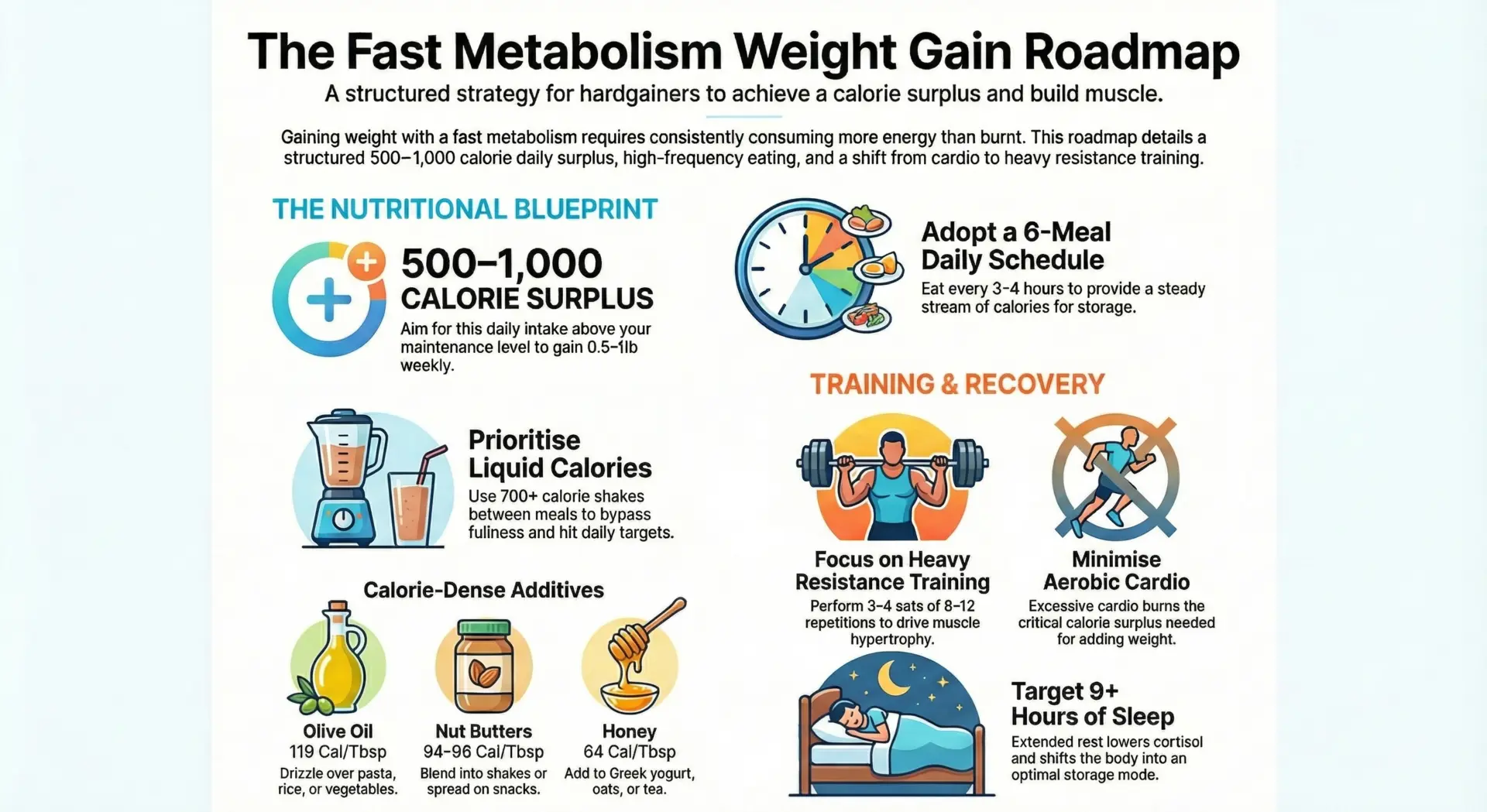
Gaining weight with a fast metabolism requires eating 500 to 1000 calories above your maintenance level daily. Eat 6 smaller meals instead of 3 large ones. Focus on calorie-dense foods like peanut butter, olive oil, whole milk, and trail mix. Drink weight gainer shakes between meals. Lift weights 3 times per week and skip cardio. Sleep 8 to 9 hours nightly. Most people with fast metabolisms can gain 0.5 to 1 pound weekly on this approach.
Calculate your calorie surplus
Before adding food to your plate, you need a number to aim for. Your maintenance calories, the amount that keeps your weight stable, sets the baseline. The American Council on Exercise recommends using body weight multipliers as a starting point.
Step 1: Find maintenance calories
Men typically multiply their body weight in pounds by 16 to 18. Women multiply by 14 to 16. A 150-pound male would have a maintenance intake around 2,400 to 2,700 calories daily.
Step 2: Add your surplus
| Goal | Weekly Gain | Surplus | Example (150lb male) |
| Slow | 0.5 lb | +300-500 cal | 3,000-3,200 cal |
| Medium | 1 lb | +500-750 cal | 3,200-3,450 cal |
| Fast | 1.5-2 lb | +1,000 cal | 3,700 cal |
People with fast metabolisms often need an additional 300 calories on top of standard surplus recommendations. If you target 500 extra calories and see no weight change after two weeks, bump it up to 800. Track everything in a fitness app for accurate monitoring.
6 meals per day beats 3 big meals
A fast metabolism burns through food constantly. Three large meals leave long gaps where your body has nothing to store. Eating every 3 to 4 hours keeps a steady stream of calories available.
Research published in the Journal of the International Society of Sports Nutrition shows that meal frequency can influence body composition when total calories remain constant.
Sample day: 3,700 calories
| Time | Meal | Calories |
| 8:00 AM | Oats + peanut butter + whole milk | 850 |
| 11:00 AM | Protein shake + banana | 650 |
| 2:00 PM | Chicken rice bowl + avocado | 900 |
| 5:00 PM | Greek yogurt + trail mix | 650 |
| 8:00 PM | Steak + potatoes + butter | 950 |
| 10:00 PM | Cottage cheese + honey | 700 |
Liquid calories go down easier than solid food when your appetite fades. A 600-calorie shake takes two minutes to drink. A 600-calorie meal might sit in front of you for 30 minutes. Use shakes strategically between meals to hit your daily target without feeling stuffed.
Top 10 calorie-dense foods for fast metabolism
Calorie density matters when stomach space is limited. These foods deliver the most energy per tablespoon, making it easier to reach your surplus without feeling overly full. The USDA FoodData Central database provides the nutritional values below.
| Food | Calories per Tbsp | Daily Use |
| Olive oil | 119 | Drizzle on rice, pasta, vegetables |
| Almond butter | 98 | Spread on toast, blend in shakes |
| Peanut butter | 94 | Add to oatmeal, smoothies, snacks |
| Heavy cream | 51 | Add to coffee, sauces, shakes |
| Trail mix | ~80 | Snack between meals, 1 cup daily |
| Whole milk | 9 | Replace water in recipes, drink with meals |
| Avocado | ~25 | Add to bowls, sandwiches, smoothies |
| Cheese (cheddar) | ~28 per slice | Top eggs, burgers, pasta |
| Dried fruit | ~15 | Mix with nuts for calorie-dense snack |
| Honey | 64 | Sweeten yogurt, oatmeal, shakes |
A simple trick: add 3 tablespoons of olive oil to a rice and chicken bowl. That is 350 extra calories you will barely notice. Cooking with oil instead of water or broth adds calories without changing portion sizes.
Weight gainer shakes: 700-1,200 calories per serving
Shakes solve the problem of eating when you are not hungry. Drinking calories bypasses some of the satiety signals that make large meals difficult. You can build your own or use a commercial mass gainer.
Homemade shake recipe (950 calories)
Blend together: 2 bananas (200 cal), 2 cups whole milk (300 cal), 1 scoop whey protein (120 cal), 4 tablespoons peanut butter (380 cal), and 1 cup oats (300 cal). Total: approximately 1,300 calories in one pint.
Commercial options
Optimum Nutrition Serious Mass provides 1,250 calories per serving. Naked Mass offers 1,230 calories with cleaner ingredients and less added sugar. Both work well for people who struggle to prepare food frequently.
Timing matters. Drink one shake after your workout when your body is primed for nutrient uptake. Have another before bed to fuel overnight recovery. That is 2,000+ liquid calories without touching a fork.
Strength training (not cardio) 3 times per week
Cardio burns the calories you need for weight gain. Running, cycling, and high-intensity interval training all increase your energy expenditure, working against your surplus. Strength training does the opposite: it builds muscle tissue that stores calories and raises your baseline weight.
The American College of Sports Medicine recommends resistance training for muscle hypertrophy using 3 to 4 sets of 8 to 12 repetitions per exercise. Focus on compound movements that work multiple muscle groups.
| Day | Focus | Primary Exercises |
| Day 1 | Chest and shoulders | Bench press 4×8, overhead press 3×10 |
| Day 2 | Legs | Squats 4×10, leg press 3×12 |
| Day 3 | Back and arms | Deadlift 3×8, rows 3×10, curls 3×12 |
Progressive overload drives muscle growth. Add 2.5 to 5 pounds to the bar each week, or increase reps before adding weight. Muscles grow during rest, not during the workout itself. Give each muscle group 48 to 72 hours of recovery before training it again.
Protein intake supports this process. Aim for 0.7 to 1 gram of protein per pound of body weight daily. A 150-pound person needs 105 to 150 grams of protein spread across meals and shakes.
Sleep 9+ hours for metabolism slowdown
Research from the University of Chicago shows that sleep-deprived individuals burn more calories at rest, the opposite of what you want when trying to gain weight. Extended sleep reduces cortisol levels and shifts your body toward storage mode.
Night protocol
Target 9 hours in bed, ideally from 10 PM to 7 AM. Avoid screens for one hour before sleep. Eat a carbohydrate-heavy dinner with rice or potatoes to promote drowsiness. The National Sleep Foundation confirms that 7 to 9 hours is the recommended range for adults, but those trying to gain weight benefit from the higher end.
Supplements for hardgainers
Supplements cannot replace food, but a few products genuinely help people who struggle to gain weight.
Creatine monohydrate: 5 grams daily adds 2 to 4 pounds of water and muscle weight within the first month. It is the most researched sports supplement available. The International Society of Sports Nutrition considers it safe and effective for increasing muscle mass.
Whey and casein protein blend: A shake with both fast-digesting whey and slow-digesting casein provides 40 to 50 grams of protein and supports muscle protein synthesis over several hours.
MCT oil: 130 calories per tablespoon. Mixes easily into coffee or shakes without changing flavor significantly. Provides quick energy without filling you up.
Avoid fat burners and stimulants. These products accelerate metabolism, making weight gain harder. Stick to foods, protein, and creatine.
4-week fast metabolism weight gain challenge
Start conservatively and increase intake based on results. Jumping straight to a 1,500-calorie surplus causes digestive discomfort and fat gain without corresponding muscle.
Week 1: Add 500 calories above maintenance. Establish your 6-meal schedule. Track everything.
Week 2: Increase to a 750-calorie surplus. Add one weight gainer shake daily. Begin strength training if you have not already.
Week 3: Push to a 1,000-calorie surplus. Add a second shake. Focus on progressive overload in your lifts.
Week 4: Weigh yourself and measure. Adjust calories up or down based on the scale. Expect 4 to 8 pounds gained, roughly half muscle and half fat if training consistently.
Weight gain takes time. Aiming for 0.5 to 1 pound per week is sustainable and minimizes excess fat accumulation. Patience matters more than perfection.
Disclaimer: This information is intended for general knowledge and informational purposes only and does not constitute medical advice. Always consult with a healthcare professional for personalized guidance.
Written by the Pandameds.com Editorial Team
Our content is created by pharmacy-trained researchers and healthcare specialists and rigorously reviewed by a diverse panel of authentic experts from the pharmaceutical and healthcare fields. This collaborative review process ensures that every article meets the highest standards of medical accuracy, reliability, and relevance.
- ✅ Authored by pharmacy-trained professionals
- 🔍 Reviewed by multiple verified experts in the pharmaceutical and healthcare niche
- 💊 Based on trusted sources including FDA, Health Canada, and peer-reviewed clinical studies
- 🔄 Regularly reviewed and updated every 90 days to maintain accuracy and trustworthiness
About Pandameds.com
Pandameds.com offers a range of weight loss medications at an affordable price.
Fast, Reliable Shipping to the USA!
Affordable Prescription Meds From Canada




Join our mailing list for exclusive promos, curated health content & more.
Frequently Asked Questions
How do you gain weight with a high metabolism?
Liquid calories make the difference. Weight gainer shakes at 700+ calories each allow you to consume more without feeling overly full. Add olive oil to cooked meals. Spread peanut butter on everything. Drink whole milk instead of water. These strategies add hundreds of calories daily without requiring larger portion sizes.
What foods help you gain weight fast?
Peanut butter, almond butter, olive oil, whole milk, Greek yogurt, trail mix, avocados, cheese, dried fruit, and honey all pack calories into small portions. Combine them with protein sources like chicken breast, eggs, cottage cheese, and canned beans. Starchy carbohydrates such as rice, pasta, oats, and potatoes provide energy for workouts and recovery.
Is being underweight dangerous?
Being underweight increases the risk of a weakened immune system, bone fractures, nutrient deficiencies, and fertility problems. The World Health Organization defines underweight as a BMI below 18.5. If you fall into this category, gaining weight through proper nutrition improves overall health outcomes.
Related Blog Posts

Call Us Today!
If you have any questions, please email our support team at support@pandameds.com or call us toll-free at 1-888-862-1210.